USAID DEC
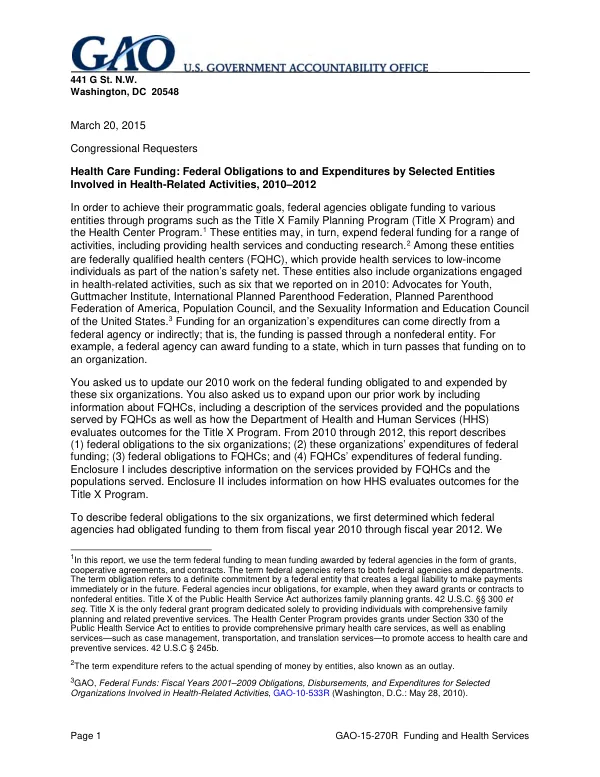
Health Care Funding: Federal Obligations to and Expenditures by Selected Entities Involved in Health-Related Activities, 2010–2012
Sign inADVOCATES FOR YOUTH
Health Care Funding: Federal Obligations to and Expenditures by Selected Entities Involved in Health-Related Activities, 2010–2012
Health Care Funding: Obligations to and Expenditures by Selected Entities Involved in Health-Related Activities, 2010-2012 Federal agencies obligate funding to various entities through programs such as the Title X Family Program and the Health Center Program.
2015 · 54 pages
Sign in to readA free account is required to download.
Abstract
These entities may expend federal funding to provide health services and conduct research. Federally qualified health centers (FQHCs) provide health services to low-income individuals and are among the entities included in this report. Six organizations were selected for review: Advocates for Youth, Guttmacher Institute, International Planned Parenthood Federation, Planned Parenthood Federation of America, Population Council, and the Sexuality Information and Education Council of the United States. From 2010 to 2012, the Department of Health and Human Services (HHS) and the U.S. Agency for International Development (USAID) primarily obligated funding to the six organizations. Data on funding obligated to the six organizations was obtained from HHS and USAID. The data included information on an organization's affiliates or member associations, when applicable. To describe the six organizations' expenditures of federal funding, available single audits submitted by organizations to the Federal Audit Clearinghouse from fiscal year 2010 through fiscal year 2012 were reviewed, as well as financial data directly from the organizations. Almost 80 percent of federal obligations to FQHCs came from HHS, and additional detailed data on funding to FQHCs was obtained from the department. Expenditures of federal funding by FQHCs were reviewed using data from the Uniform Data System, maintained by the Health Resources and Services Administration (HRSA). The data included information on patient demographics, services provided, utilization rates, and revenues. Federal agencies reported obligations by federal fiscal year, while FQHCs reported expenditures by their varying fiscal years. The amounts are not comparable for specific time periods. The obligations and expenditure data obtained were determined to be sufficiently reliable for the purposes of this report. The work was conducted from 2013 to 2015 in accordance with GAO's Quality Assurance Framework. The Department of Veterans Affairs obligated $900 to one of the organizations, and the Department of State obligated $136,000 to another. However, these amounts accounted for less than one percent of the total obligations, and these departments were excluded from the analysis. The data on the value of certain commodities provided by USAID to the organizations was noted separately from the analysis of USAID obligations. The six organizations included in this report are affiliates or member associations of the organizations listed. An affiliate or member association refers to an organization that is associated with another as a subordinate or subsidiary. Affiliates or member associations of the organizations operate separately and may be legal entities from the parent organization. Funding for affiliates or member associations may come directly from a federal agency or indirectly, passed through a nonfederal entity. The Uniform Data System tracks a variety of information about FQHCs, including patient demographics, services provided, utilization rates, and revenues. The data are limited to only those sources reported to HRSA by the FQHCs and do not include funding for lines of business FQHCs might operate. Federal agencies reported obligations by federal fiscal year, while FQHCs reported expenditures by their varying fiscal years. The amounts are not comparable for specific time periods. The obligations and expenditure data obtained were determined to be sufficiently reliable for the purposes of this report. The work was conducted from 2013 to 2015 in accordance with GAO's Quality Assurance Framework. The framework requires that we plan and perform the work to obtain sufficient and appropriate evidence to meet our objectives and to discuss any limitations in our work. We believe that the information and analysis provide a reasonable basis for any findings and conclusions in this product.