USAID DEC
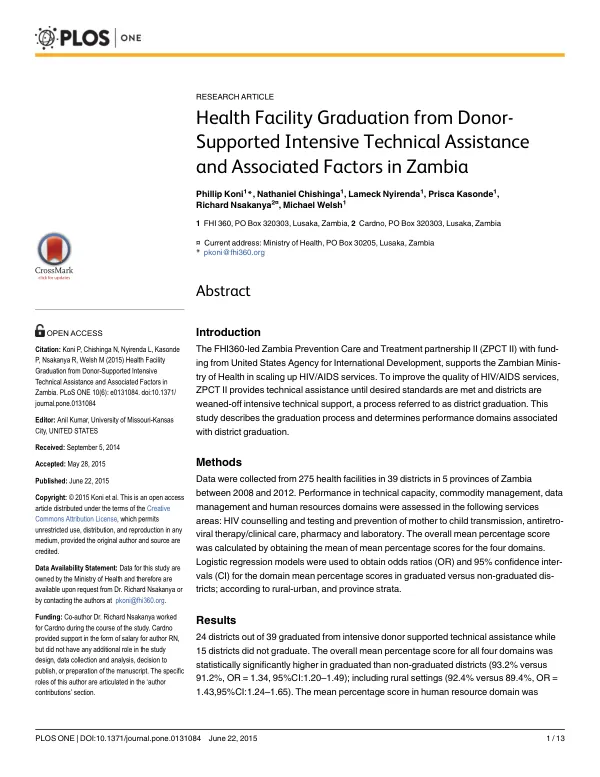
Health Facility Graduation from Donor-Supported Intensive Technical Assistance and Associated Factors in Zambia
Sign inFHI 360
Health Facility Graduation from Donor-Supported Intensive Technical Assistance and Associated Factors in Zambia
The Zambia Prevention, Care and Treatment Partnership II (ZPCT II) supports the Zambian Ministry of Health in scaling up HIV/AIDS services in 5 provinces of Zambia.
2015 · 13 pages
Sign in to readA free account is required to download.
Abstract
The partnership, funded by the United States Agency for International Development (USAID), provides technical assistance to health facilities until desired standards are met and districts are weaned-off intensive technical support, a process referred to as district graduation. This study aims to describe the graduation process and determine performance domains associated with district graduation. Data were collected from 275 health facilities in 39 districts in 5 provinces of Zambia between 2008 and 2012. Performance in technical capacity, commodity management, data management, and human resources domains were assessed in the following services areas: HIV counselling and testing and prevention of mother to child transmission, antiretroviral therapy/clinical care, pharmacy, and laboratory. The overall mean percentage score was calculated by obtaining the mean of mean percentage scores for the four domains. Logistic regression models were used to obtain odds ratios (OR) and 95% confidence intervals (CI) for the domain mean percentage scores in graduated versus non-graduated districts; according to rural-urban, and province strata. The results show that 24 districts out of 39 graduated from intensive donor-supported technical assistance while 15 districts did not graduate. The overall mean percentage score for all four domains was statistically significantly higher in graduated than non-graduated districts (93.2% versus 91.2%, OR = 1.34, 95% CI: 1.20-1.49). The mean percentage score in the human resources domain was statistically significantly higher in graduated than non-graduated districts (93.6% versus 71.6%, OR = 5.81, 95% CI: 4.29-7.86) and in both rural and urban settings. The study concludes that QA/QI tools can be used to assess performance at health facilities and determine readiness for district graduation. Human resources management domain was found to be an important factor associated with district graduation. The results suggest that the QA/QI system used in this study can be an effective tool for operationalizing sustainability of HIV/AIDS services in resource-limited settings. The concept of sustainability can be operationalized by grouping determining factors into three clusters: context (environmental factors), activity profile (type of services offered or activities carried out), and organizational capacity (capability to carry out set tasks faced by the organization). These factors interact in different ways; the identification of gaps in these factors illuminates barriers to sustainability of services. The study highlights the importance of addressing all four elements of sustainability, including technical, programmatic, social, and financial elements, to achieve operational sustainability. The study's findings have implications for project design and implementation, particularly in the context of HIV/AIDS services in resource-limited settings. The results suggest that the QA/QI system can be an effective tool for preparing districts for graduation from project support by improving the quality of services at individual health facilities and building up the districts' ability to manage HIV services.
Related documents
Documents in this collection
 2014
2014USAID DEC
Perceptions of Male Involvement in the Prevention of Mother-to-Child Transmission of HIV (PMTCT) Services in the Democratic Republic of Congo: Opportunities for Social and Behavior Change Communication
Open record 2015
2015USAID DEC