USAID
Health Financing Indicators
Health Financing Indicators are a set of metrics used to assess the performance of health financing systems.
2015 · 56 pages
Sign in to readA free account is required to download.
Abstract
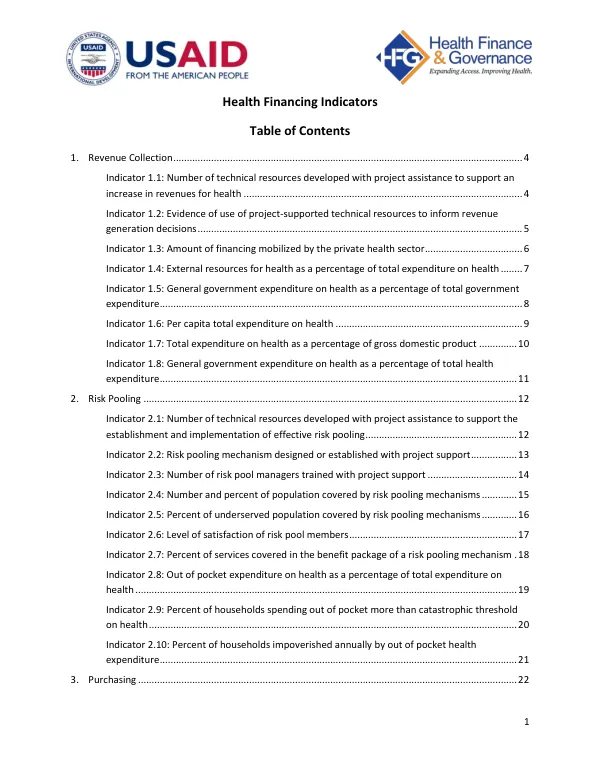
The indicators are categorized into four main areas: Revenue Collection, Risk Pooling, Purchasing, and Cross-cutting indicators. Revenue Collection indicators focus on the mobilization of resources for health. Indicator 1.1 measures the number of technical resources developed with project assistance to support an increase in revenues for health. Evidence of use of project-supported technical resources to inform revenue generation decisions is measured by Indicator 1.2. The amount of financing mobilized by the private health sector is tracked by Indicator 1.3. External resources for health as a percentage of total expenditure on health are measured by Indicator 1.4, while Indicator 1.5 tracks general government expenditure on health as a percentage of total government expenditure. Per capita total expenditure on health is measured by Indicator 1.6, and total expenditure on health as a percentage of gross domestic product is tracked by Indicator 1.7. General government expenditure on health as a percentage of total health expenditure is measured by Indicator 1.8. Risk Pooling indicators focus on the establishment and implementation of effective risk pooling mechanisms. Indicator 2.1 measures the number of technical resources developed with project assistance to support the establishment and implementation of effective risk pooling. A risk pooling mechanism designed or established with project support is measured by Indicator 2.2, while the number of risk pool managers trained with project support is tracked by Indicator 2.3. The number and percent of population covered by risk pooling mechanisms are measured by Indicator 2.4, and the percent of underserved population covered by risk pooling mechanisms is tracked by Indicator 2.5. Level of satisfaction of risk pool members is measured by Indicator 2.6, and the percent of services covered in the benefit package of a risk pooling mechanism is tracked by Indicator 2.7. Out of pocket expenditure on health as a percentage of total expenditure on health is measured by Indicator 2.8, and the percent of households spending out of pocket more than catastrophic threshold on health is tracked by Indicator 2.9. The percent of households impoverished annually by out of pocket health expenditure is measured by Indicator 2.10. Purchasing indicators focus on the strengthening of provider payment mechanisms and the establishment of performance-based payment systems. Indicator 3.1 measures the number of technical resources developed with project support to strengthen provider payment mechanisms. The number of claims incurred ratio is tracked by Indicator 3.2, and the incurred claims ratio (also known as medical loss ratio) is measured by Indicator 3.3. Total loss ratio is tracked by Indicator 3.4, and claims rejection ratio is measured by Indicator 3.5. Claims settlement is tracked by Indicator 3.6, and the number and percent of health care providers empaneled or accredited into risk pooling mechanism are measured by Indicator 3.7. Performance-based payment systems are also tracked, with Indicator 3.8 measuring the number of technical resources developed with project support to assist the establishment or implementation of effective performance-based payment systems. A performance-based payment system designed or introduced with project support is measured by Indicator 3.9, and a performance-based payment system that rewards service quality is tracked by Indicator 3.10. The number and percent of entities who signed a performance-based payment contract are measured by Indicator 3.11, and the percent of performance-based payments funded by domestic resources is tracked by Indicator 3.12. Performance-based payments are managed by target recipients, as measured by Indicator 3.13. The percent of recipients in a performance-based payment system that submit required performance data correctly and on time is tracked by Indicator 3.14, and the percent of the sample of performance reports by recipients in a performance-based payment system identified for verification that are verified is measured by Indicator 3.15. The percent of recipients in a performance-based payment system that meet their performance targets is tracked by Indicator 3.16, and the percent of recipients in a performance-based payment system meeting performance targets that receive payments on time is measured by Indicator 3.17. Performance results for recipients participating in a performance-based payment system are disseminated or available to the public, as measured by Indicator 3.18. The value of indicator targeted by a performance-based payment system in a given time period is tracked by Indicator 3.19. Demand-side financing programs are also tracked, with Indicator 3.20 measuring the number of technical resources developed with project support to assist in the establishment and implementation of demand-side financing programs. A demand-side financing program designed or introduced with project support is measured by Indicator 3.21, and the percent of demand-side financing recipients who meet target recipient characteristics is tracked by Indicator 3.22. The number and percent of health care vouchers redeemed are measured by Indicator 3.23, and a functioning verification system for a demand-side financing program established or strengthened with project support is tracked by Indicator 3.24. The percent of health care voucher
Related documents