USAID DEC
The Time is Now to Accelerate Women's Public Procurement: Snapshot: Gender-Sensitive Public Procurement Survey
Sign inBANK FOR WEST AFRICAN DEVELOPMENT
The Time is Now to Accelerate Women's Public Procurement: Snapshot: Gender-Sensitive Public Procurement Survey
The USAID-created 23-part toolbox and call to action series, The Time Is Now To Accelerate Women’s Public Procurement, focuses on promoting gender-sensitive public procurement practices among international entities.
2021 · 2 pages
Sign in to readA free account is required to download.
Abstract
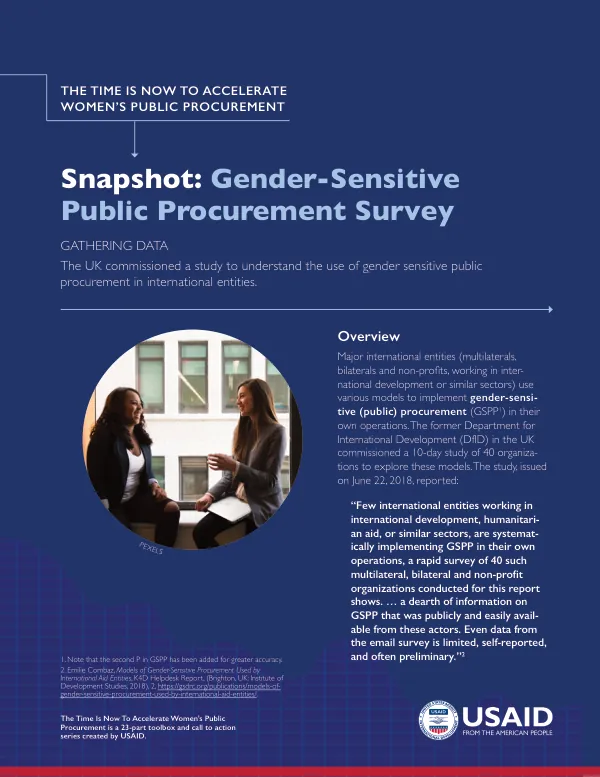
A commissioned study by the UK's former Department for International Development (DfID) aimed to understand the use of gender-sensitive public procurement in international entities. The study, conducted in 2018, involved a rapid survey of 40 major international entities, including multilaterals, bilaterals, and non-profits working in international development or similar sectors. The study found that few international entities systematically implement gender-sensitive public procurement (GSPP) in their operations. A lack of publicly available information on GSPP was also identified, with even survey data being limited, self-reported, and often preliminary. The study highlighted the need for greater awareness and implementation of GSPP practices among international entities. Table 1 provides an overview of the GSPP practices among the surveyed organizations. The table shows that only a few organizations, such as the Asian Development Bank, the International Finance Corporation, and UN Women, have instituted GSPP programs. Many organizations, including the Gates Foundation, Denmark, and the Netherlands, are considering implementing GSPP but have not yet done so. Others, such as the World Health Organization and the World Bank Group, have started implementing GSPP but lack detailed information on their models. The study's findings suggest that there is a need for greater acceleration of women's public procurement practices among international entities. The toolbox and call to action series aim to provide guidance and support for organizations to implement GSPP practices and promote women's empowerment through public procurement. The series includes 23 parts, which provide practical tools, case studies, and guidance on implementing GSPP practices. The study's results have implications for international development and humanitarian aid organizations, highlighting the need for greater attention to GSPP practices and women's empowerment through public procurement. The toolbox and call to action series aim to support organizations in implementing GSPP practices and promoting women's empowerment, ultimately contributing to more inclusive and equitable development outcomes.