THE BILL AND MELINDA GATES FOUNDATION
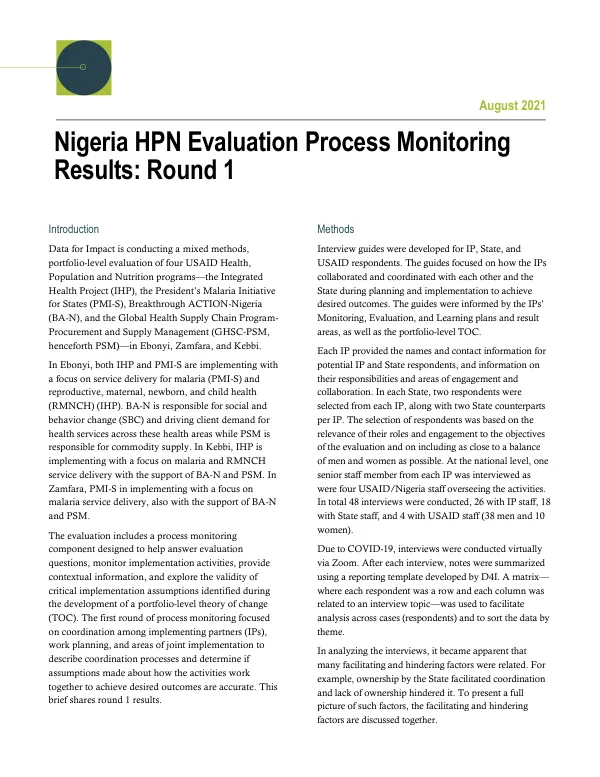
Nigeria HPN Evaluation Process Monitoring Results: Round 1
The evaluation of the USAID Health, Population and Nutrition programs in Nigeria's Ebonyi, Zamfara, and Kebbi states aimed to assess collaboration and coordination among implementing partners (IPs) and the states during extraordinary times.
2021 · 13 pages
Sign in to readA free account is required to download.
Abstract
The study examined how the IPs and states collaborated and coordinated with each other to achieve desired outcomes. The evaluation included a process monitoring component, which involved conducting 48 interviews with IP staff, state staff, and USAID staff. The interviews were conducted virtually via Zoom due to COVID-19 restrictions. The data was analyzed using a matrix to facilitate analysis across cases and to sort the data by theme. The study found that COVID-19 and security issues hindered implementation in all three states. In Ebonyi, COVID-19 hindered the delivery of key activities, while in Kebbi and Zamfara, security issues such as kidnapping, banditry, and violence impacted implementation. A national IP respondent noted that BA-N was impacted the most by COVID-19 and security issues due to their community-based work. The IPs have a monthly coordination meeting in all three states, which is also attended by a member of the state malaria elimination program in Zamfara. The IPs provide technical and financial support for state coordination meetings and technical working groups (TWGs). The IPs build the capacity of members and ensure that action points are followed up. At the national level, the IPs have monthly coordination meetings to align strategies and implementation approaches. An example of coordination at the national level involved IHP and PMI-S coordinating a malaria microscopy training that was to be rolled out in all PMI-S and IHP states. National IP staff participate in national-level TWGs and coordinate with other donor partners. The study identified three main categories of factors that impacted coordination and implementation among IPs and with the state: factors related to coordination structures, system-level factors, and factors related to sustainability. Within these categories, several themes emerged, including the mandate to coordinate, monthly IP coordination meetings, and the importance of coordination structures. The IPs have a mandate from USAID to collaborate and coordinate, which affects the measurement of each individual IP's performance. However, a national IP respondent noted that the IPs' individual mandates and perspectives related to their area of specialization were overarching challenges to the mandate to coordinate. The monthly IP coordination meetings facilitated coordination by enabling the IPs to review progress, share experiences, and identify implementation challenges. The meetings also ensured that a unified message was presented to the state and coordinated their agenda for advocacy. The IPs reported that their coordination meetings helped to avoid a "clash of activities" and leverage resources. The study found that most themes were common across states, and the IPs' coordination structures played a crucial role in facilitating coordination and implementation. The evaluation highlights the importance of coordination and collaboration among IPs and with the state in achieving desired outcomes in the context of extraordinary times.