USAID DEC
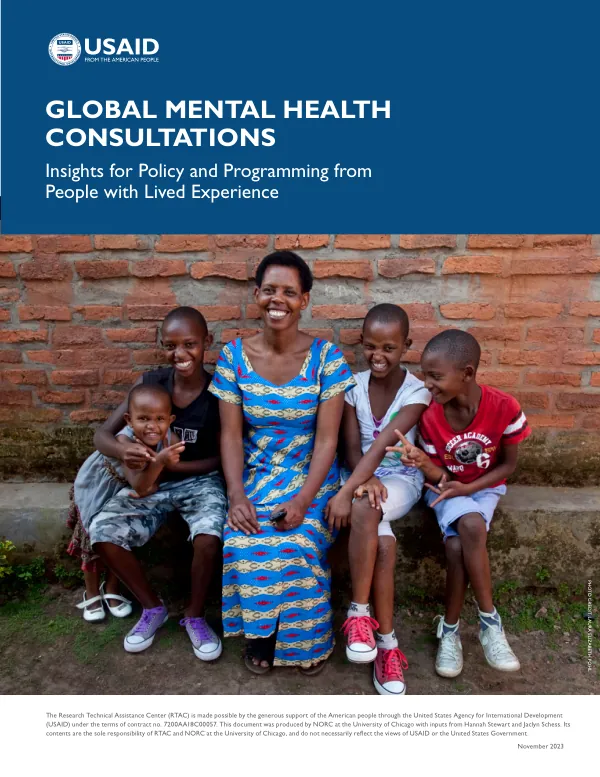
Global Mental Health Consultations. Insights for Policy and Programming from People with Lived Experience
Sign inNORC AT THE UNIVERSITY OF CHICAGO
Global Mental Health Consultations. Insights for Policy and Programming from People with Lived Experience
The importance of mental health to individual well-being, as well as social and economic progress, is becoming more widely recognized.
2023 · 4 pages
Sign in to readA free account is required to download.
Abstract
Mental health challenges result in untold human suffering, lost productivity, social isolation, and decreased quality of life. People in vulnerable situations, such as those affected by war, displacement, and natural disasters, are disproportionately affected by mental health problems. Despite the clear contribution mental health makes to human and social development, it remains stigmatized, undervalued, and underfunded in many regions of the world. The United States Agency for International Development (USAID) commissioned the Research Technical Assistance Center (RTAC) to carry out a consultation process to elicit feedback on the difficulties and opportunities encountered by different stakeholder groups. This process took place between late 2022 and early 2023. The RTAC team collaborated with USAID staff in the planning of the consultations, which were structured to cover causes, challenges, and barriers in global mental health; principles and approaches to mental health; and recommendations for mental health policy and programming. Eleven consultation sessions were held specifically with people with lived experiences, representing 31 individuals from 14 different countries. The representation included robust participation from parts of East Africa, South Asia, and Southeast Asia, but was limited in Latin America and Europe. The consultations were conducted online by two facilitators, Hannah Stewart and Jaclyn Schess, using an online collaborative tool to allow participants to contribute their feedback verbally or through adding inputs to the collaborative space themselves. People with lived experience were defined as individuals with life experiences involving systematic power dynamics of oppression, including both first-person accounts and expert knowledge. This definition was constructed by considering both phenomenological and standpoint theories. Phenomenology suggests that lived experience represents knowledge that people gain from first-hand experience, living the phenomena of interest. Standpoint theory contains a recognition of power and marginalization that complements this phenomenological outlook. Across the consultations, four key themes emerged: stigma and discrimination, challenging policy landscapes, availability of various services, and youth mental health. People with lived experience often identified mental health challenges as being intertwined with societal and structural issues related to discrimination, poverty, and lack of political priority. They emphasized that successful mental health policies would increase the number of people accessing community-based, culturally appropriate mental health supports, embed mental health across organizations' work, and lead to organization-wide frameworks for lived experience engagement. Participants had several recommendations to ensure that mental health programming and policy is effective for people with lived experience. These include developing an organizational framework for lived experience engagement, positioning people with lived experience as experts, paying people with lived experience for their expertise, building capacity of and partnering with lived experience-led organizations, and integrating indicators of recovery into monitoring and evaluation efforts. Additionally, people with lived experience highlighted the need to prioritize principles including safeguarding human rights, inclusion and participation of people with lived experience and community members, emphasizing prevention and recovery, recognizing the need for evidence generation, and sustainability of program and outcomes.