USAID DEC
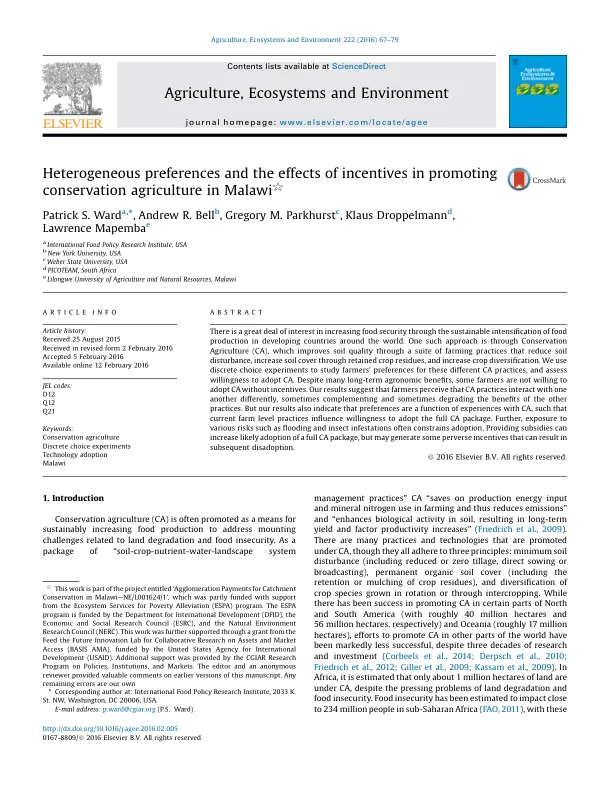
Heterogeneous preferences and the effects of incentives in promoting conservation agriculture in Malawi
Sign inELSEVIER LTD.
Heterogeneous preferences and the effects of incentives in promoting conservation agriculture in Malawi
Conservation agriculture (CA) is a package of soil-crop-nutrient-water-landscape system management practices that saves on production energy input and mineral nitrogen use in farming, reducing emissions and enhancing biological activity in soil.
2016 · 13 pages
Sign in to readA free account is required to download.
Abstract
This results in long-term yield and factor productivity increases. CA adheres to three principles: minimum soil disturbance, permanent organic soil cover, and diversification of crop species grown in rotation or through intercropping. In Malawi, current agricultural practices exacerbate the problem of low soil fertility, leading to soil erosion and decreased agricultural productivity. Despite the pressing problems of land degradation and food insecurity, adoption of CA in Malawi has proven difficult. While interest in CA has increased since the food price crisis of 2007/8, adoption still lags behind that of other countries. Malawi's Agriculture Sector Wide Approach (ASWAp) promotes CA through a range of conservation agriculture techniques, including maintaining soil cover, minimum tillage, and land-use diversification. Studies have examined CA adoption in Malawi and elsewhere in sub-Saharan Africa, finding that the disappointing uptake may be due to inappropriate adaptation of CA practices to fit within local farming systems or inadequately designed CA policies with insufficient economic incentives to overcome barriers to adoption for local farmers. Impediments to adoption have been identified as a lack of information about CA management practices, uncertainty concerning full economic costs and benefits of CA practices, sensitivity to increases in yield variability, shorter planning horizons, land tenure status, and high discount rates. The lack of information/technical knowledge on CA management practices is not only on the part of farmers but also on the part of field extension workers who work directly with farmers. If extension agents lack detailed knowledge about CA, this would impede the successful transmission of knowledge of CA and ultimately result in low levels of adoption. Resource constraints may lead farmers to dis-adopt CA practices or to be in noncompliance with CA agreements before they realize personal gains from CA techniques. The various technologies and practices promoted under CA provide benefits in terms of yields or farm profits that accrue inconsistently over time and space, and these benefits often fail to outweigh the economic costs associated with adoption. This is perhaps particularly true for residue retention and mulching. In Malawi's case, some farmers have adopted minimum tillage and maize intercropping with legumes, but tend not to cover crops with mulched residues. In mixed crop-livestock systems, there are opportunity costs associated with retaining and mulching crop residues, as this reduces the amount of "free" fodder available for livestock. The study of heterogeneity in preferences and the effects of incentives in promoting CA in Malawi uses discrete choice experiments to study farmers' preferences for different CA practices and assess willingness to adopt CA. The results suggest that farmers perceive that CA practices interact with one another differently, sometimes complementing and sometimes degrading the benefits of the other practices. Preferences are a function of experiences with CA, such that current farm-level practices influence willingness to adopt the full CA package. Exposure to various risks such as flooding and insect infestations often constrains adoption. Providing subsidies can increase likely adoption of a full CA package, but may generate some perverse incentives that can result in subsequent disadoption.
Related documents
Documents in this collection
 2018
2018USAID DEC
An Evaluation of the Level of Integration and Alignment of the Malabo Commitments, Africa’s Agenda 2063 and the SDGs in 10 National Agriculture and Food Security Investment Plans
Open record 2018
2018USAID DEC
![NAPAS:Malawi Annual Work Plan [FY2016]](https://covers.devme.ai/gen/145459.webp)