USAID DEC
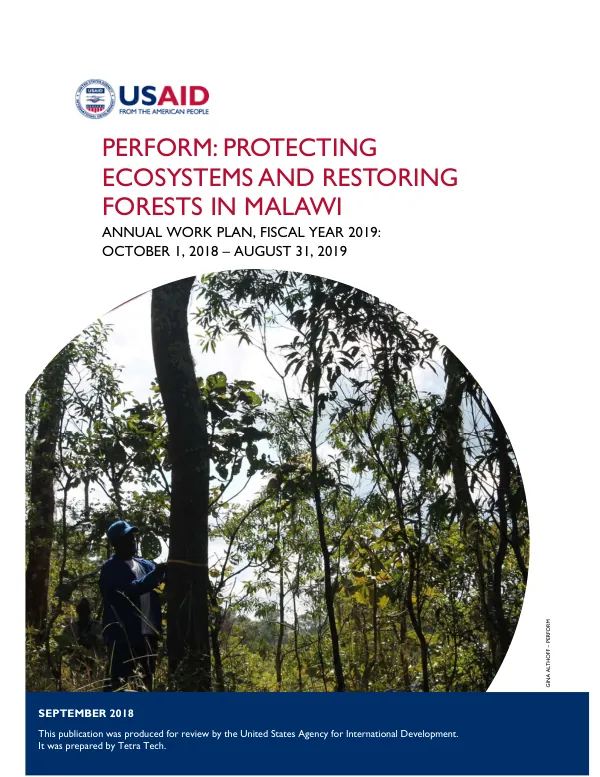
PERFORM ANNUAL WORK PLAN, FISCAL YEAR 2019: PROTECTING ECOSYSTEMS AND RESTORING FORESTS IN MALAWI
Sign inTETRA TECH
PERFORM ANNUAL WORK PLAN, FISCAL YEAR 2019: PROTECTING ECOSYSTEMS AND RESTORING FORESTS IN MALAWI
The Protecting Ecosystems and Restoring Forests in Malawi initiative began in 2018 with funding from the United States Agency for International Development (USAID).
2019 · 71 pages
Sign in to readA free account is required to download.
Abstract
The program aimed to advance REDD+ readiness, increase low-emissions land use opportunities, improve low-emissions development capacities, and establish pathways for sustainability. The initiative was implemented in targeted geographies, including districts in Malawi. The program's objectives were to advance REDD+ readiness, increase low-emissions land use opportunities, improve low-emissions development capacities, and establish pathways for sustainability. To achieve these objectives, the program focused on several key results, including increasing capacities for REDD+ data collection, analysis, and utilization, improving REDD+ relevant policy and legal frameworks, and expanding livelihood opportunities from conservation. Implementation of the program involved several key activities, including technical capacity building, functional capacity building, and decentralized forest/land management improvement. The program also focused on increasing forest cover in targeted geographies, improving forestry extension services and research capabilities, and communicating lessons learned to a wide variety of stakeholders. The program's monitoring, evaluation, and learning activities were designed to ensure data quality, facilitate collaborating, learning, and adapting, and conduct planned operations research. The program's work plan results and activities were organized around five objectives: advancing REDD+ readiness, increasing low-emissions land use opportunities, improving low-emissions development capacities, establishing pathways for sustainability, and advancing CDCS priorities of integration and institutional strengthening. The program's cross-cutting areas included district government coordination, communications, gender integration, and environmental compliance. The program's geographic coverage included several districts in Malawi, and its procurement activities were managed through a variety of mechanisms, including international travel. The program's key program indicators and targets were outlined in Appendix A, and its organizational chart was updated in Appendix B. The program's sub-partners were listed in Appendix C, and its geographic coverage was outlined in Appendix D. The program's procurements were detailed in Appendix E, and its international travel was outlined in Appendix F. The program's GHG inventory system was refined and finalized, and a web-based GHG information clearinghouse was developed. Local emission factors for agriculture and forestry were also developed, and the integration of environmental affairs' GHG accounting activities between national communications and GHG-IS was completed. The program also piloted GHG-IS for identified priority users and developed guidance on strategies for improved sustainable management of national woodfuel supply. The program's capacity building activities included training and technical assistance for government officials, civil society organizations, and private sector entities. The program's communications activities included the development of a communications strategy, the production of outreach materials, and the facilitation of stakeholder engagement. The program's results were measured against a variety of indicators, including the increase in capacities for REDD+ data collection, analysis, and utilization, the improvement in REDD+ relevant policy and legal frameworks, and the expansion of livelihood opportunities from conservation. The program's lessons learned were communicated to a wide variety of stakeholders, and its results were used to inform the national REDD+ process. The program's GHG emission reductions were measured and reported, and its results were used to inform the development of a national forest inventory. The program's capacity building activities were designed to improve the skills and knowledge of government officials, civil society organizations, and private sector entities, and its communications activities were designed to raise awareness about the importance of sustainable forest management. The program's results were used to inform the development of a national forest inventory, and its lessons learned were communicated to a wide variety of stakeholders. The program's GHG emission reductions were measured and reported, and its results were used to inform the national REDD+ process.