CARE MALAWI
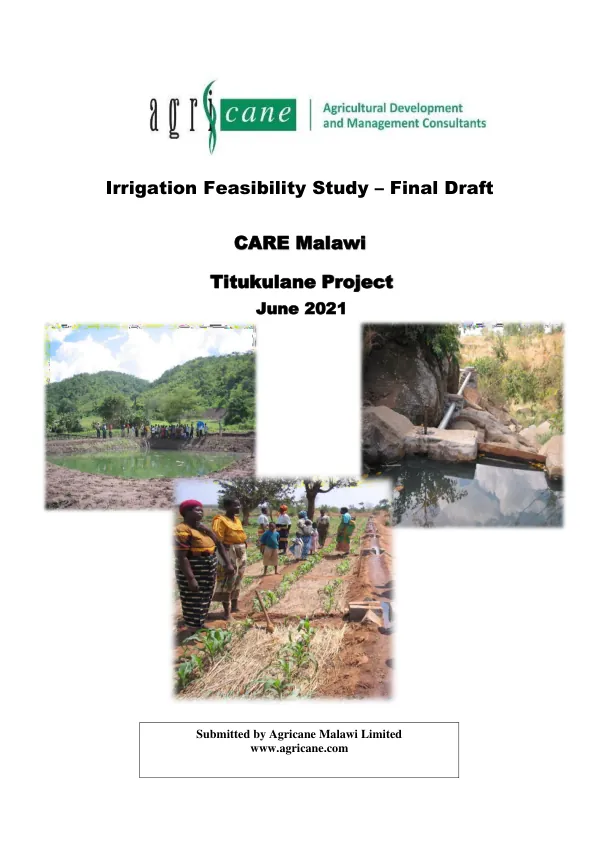
Irrigation Feasibility Study – Final Draft
The Titukulane Project is a $75 million five-year USAID-funded Development Food Security Activity (DFSA) implemented by CARE in collaboration with partners, including Emmanuel International, International Food Policy Research Institute (IFPRI), National Smallholder Farmers Association of Malawi (NASFAM), Save the Children, and Water Aid.
2021 · 67 pages
Sign in to readA free account is required to download.
Abstract
The project aims to support the implementation and effectiveness of the Malawi National Resilience Strategy (NRS), which guides investments in agriculture, reduces impacts, and improves recovery from shocks, promotes household resilience, strengthens management of Malawi's natural resources, and facilitates coordination between government institutions, civil society organizations, and development partners. The primary goal of Titukulane is to achieve sustainable, equitable, and resilient food and nutrition security for ultra-poor and chronically vulnerable households in Mangochi and Zomba Districts. The project has three main purpose areas: increasing diversified, sustainable, and equitable incomes for ultra-poor, chronically vulnerable households, women, and youth; improving nutrition status among children under five, adolescent girls, and women of reproductive age; and increasing institutional and local capacities to reduce risk and increase resilience among ultra-poor and chronically vulnerable households in alignment with the NRS. The project focuses on rural households in Mangochi and Zomba Districts, which depend on agricultural and food production for their food and nutrition security. Farmers in these districts rely on rain-fed crop production, which limits crop production to one season and presents a major constraint in maximizing farming potential and achieving food and nutrition security. The reliance on rain-fed cultivation, coupled with the potential effects of climate change, presents vital challenges to the sustainability and resilience of the agriculture sector, particularly for women and youth who face gender inequality and age discrimination. To address these challenges, Titukulane launched an Irrigation Feasibility Study to assess the extent and best possible methods of maximizing irrigation for targeted households in the two districts. The study aimed to identify existing and potential irrigation technologies, study the functionality of these technologies, and outline key constraints and opportunities faced by different demographic groups and economic backgrounds. The study also aimed to identify small-scale irrigation intervention packages with the highest Return on Investment for three priority crops and rank irrigation technologies that are suitable, sustainable, and gender-sensitive for different target categories. The feasibility assessment comprised topographical surveys, hydrogeological surveys, market access surveys, gender and youth sensitivity assessments, and cost-benefit analysis. The surveys were conducted at initially identified sites, and the most cost-effective sites were selected for development. The project emphasized gender and youth-sensitive, simple technologies to maintain cost-effectiveness, ease of adoption, and sustainability of both the technology and its management by the communities. Communities were engaged in the assessment process, and their participation, gender and youth composition, signed commitments, and existing capacity to operate and manage the irrigation system were considered. The study also assessed community capacity to manage irrigation infrastructure and equitable water distribution, quantity, and quality. Preferences of different categories, including women and youth, were discussed and assessed, and their initial consent was established on land agreements with local leaders and landholders. The agreements formalized their willingness to give up land for irrigation development and use it for irrigation during the dry season. Community systems and practices that can facilitate the successful implementation and sustainability of irrigation activities were also assessed.
Related documents
![NAPAS:Malawi Annual Work Plan [FY2016]](https://covers.devme.ai/gen/145459.webp)