UNITED NATIONS
HIV Testing and Counseling: Impact of Health Communication Interventions
HIV testing and counseling (HTC) may be strengthened through health communication interventions.
2014 · 2 pages
Sign in to readA free account is required to download.
Abstract
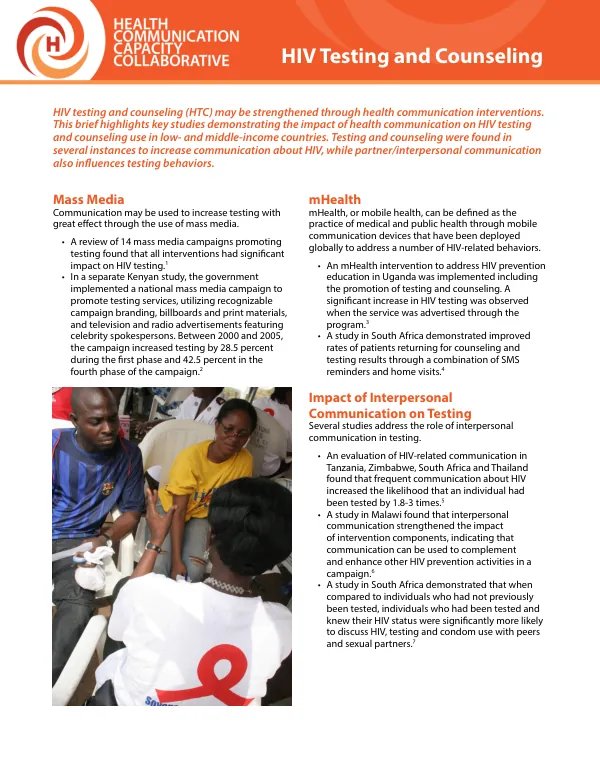
Key studies demonstrate the impact of health communication on HIV testing and counseling use in low- and middle-income countries. Testing and counseling increase communication about HIV, while partner/interpersonal communication influences testing behaviors. Mass media communication may be used to increase testing with great effect. A review of 14 mass media campaigns promoting testing found that all interventions had significant impact on HIV testing. In a separate Kenyan study, the government implemented a national mass media campaign to promote testing services, utilizing recognizable campaign branding, billboards, and print materials, and television and radio advertisements featuring celebrity spokespersons. Between 2000 and 2005, the campaign increased testing by 28.5 percent during the first phase and 42.5 percent in the fourth phase of the campaign. mHealth, or mobile health, can be defined as the practice of medical and public health through mobile communication devices that have been deployed globally to address a number of HIV-related behaviors. An mHealth intervention to address HIV prevention education in Uganda was implemented, including the promotion of testing and counseling. A significant increase in HIV testing was observed when the service was advertised through the program. A study in South Africa demonstrated improved rates of patients returning for counseling and testing results through a combination of SMS reminders and home visits. Interpersonal communication plays a significant role in testing. An evaluation of HIV-related communication in Tanzania, Zimbabwe, South Africa, and Thailand found that frequent communication about HIV increased the likelihood that an individual had been tested by 1.8-3 times. A study in Malawi found that interpersonal communication strengthened the impact of intervention components, indicating that communication can be used to complement and enhance other HIV prevention activities in a campaign. A study in South Africa demonstrated that individuals who had been tested and knew their HIV status were significantly more likely to discuss HIV, testing, and condom use with peers and sexual partners. Linkages between health communication, testing and counseling, and prevention of mother-to-child transmission (PMTCT) are evident in the literature. HTC is not only an entry point into PMTCT services for women but also influences couples' communication about STIs, which in turn positively influences testing by male partners as well as condom use. Women in Burkina Faso were eight times more likely to agree to undergo testing after discussing it with their partner; partner communication also was associated with retention in care at every level. Women in Kenya who were encouraged to return with their partners and underwent couples counseling were more likely to return to engage in PMTCT care, follow breastfeeding guidelines, and were significantly more likely to use condoms.