WORLD COUNCIL OF CREDIT UNIONS, INC.
HOME Program Quarterly Report [FY2021 Q1]
The Home Ownership and Mortgage Expansion (HOME) program in Haiti was initiated on July 1, 2015, with the goal of improving access to housing and community services.
2021 · 16 pages
Sign in to readA free account is required to download.
![HOME Program Quarterly Report [FY2021 Q1]](https://covers.devme.ai/gen/140058.webp)
Abstract
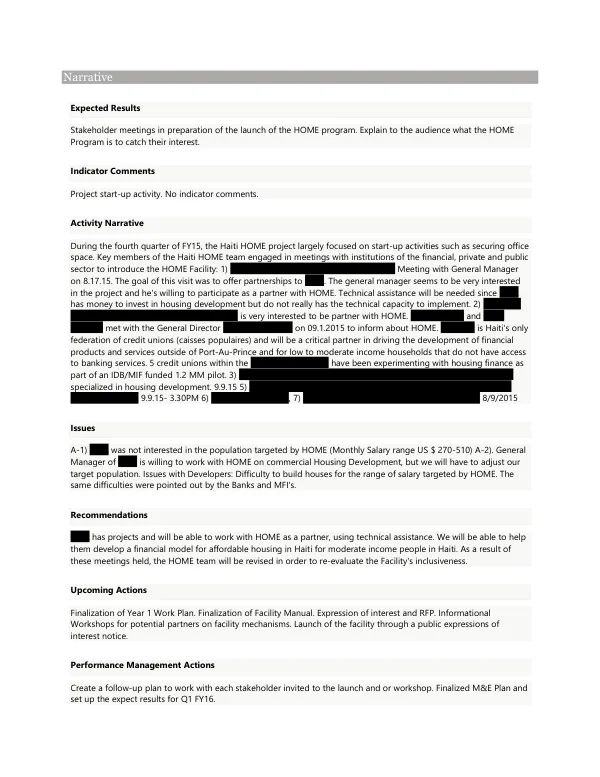
The program was designed to address the critical need for innovative solutions to unlock liquidity in the Haitian banking sector, mitigate risk for participating financial institutions, and enable low, moderate, and middle-income Haitian households to gain affordable access to housing. The HOME program's key objectives were to catalyze and incentivize the supply and demand sides of the housing value chain to create affordable housing and allow households to build or improve their homes through targeted housing finance and technical assistance. The program's strategy focused on developing a housing finance model that would provide affordable housing options for low, moderate, and middle-income households. The HOME program's progress was monitored through a series of quarterly reports, which provided updates on the program's activities, financial performance, and administrative updates. The reports also included information on the program's achievements, challenges, and lessons learned. In the final quarter of the program period, the HOME team focused on finalizing deliverables under subawards and ensuring financial and administrative readiness for closeout. The team also took initiatives to prepare partners for the end of program transition and to effectively capture results and learnings. These initiatives included a workshop with the Housing Developers' Association, the production of two promotional videos, and the development of a Pay-for-Results (PfR) case study. The PfR case study analyzed the program's methodology for designing its PfR incentive structure, its results, and lessons learned. The case study drew upon internal project documents, information obtained through interviews with key project stakeholders, and additional resources. The PfR case study was intended to leverage the experience of Haiti HOME to showcase both the potential of PfR to achieve meaningful development outcomes and the challenges inherent in designing and implementing such an initiative. As of the end of Q1 FY21, the HOME program had expended 81% of the HOME Facility catalytic grant fund. Out of 22 activities funded, seven were on the demand side and 15 were on the supply side of the housing value chain. The total private capital leveraged from partners amounted to USD 906,212, with USD 155,586 reported by one partner, USD 113,976 reported by another, USD 164,500 reported by a third, and USD 166,650 reported by a fourth. The HOME program's achievements included the development of a housing finance model that provided affordable housing options for low, moderate, and middle-income households. The program also facilitated the issuance of housing finance, including mortgages, to target groups of Haitian households by Participating Financial Intermediaries (PFIs). The program's results included the construction of houses for target Haitian households, the issuance of housing finance, and the leveraging of private capital from partners. The HOME program's lessons learned included the importance of innovative solutions to unlock liquidity in the Haitian banking sector, the need for risk mitigation for participating financial institutions, and the importance of targeted housing finance and technical assistance to enable low, moderate, and middle-income households to gain affordable access to housing. The program's experience also highlighted the potential of PfR to achieve meaningful development outcomes and the challenges inherent in designing and implementing such an initiative.
![Home Ownership and Mortgage Expansion (HOME) Program Quarterly Report [Q3 FY 2016]](https://covers.devme.ai/gen/151827.webp)
![Home Ownership and Mortgage Expansion (HOME) Program Quarterly Report [Q2 FY 2016]](https://covers.devme.ai/gen/150276.webp)
![HOME Program Quarterly Report / Annual Report [Q4 FY 2016]](https://covers.devme.ai/gen/152299.webp)