USAID DEC
Homes and Communities (Uburezi Iwacu) Activity Report: Report on the Mapping of Community Literacy
Sign inUSAID DEC
Homes and Communities (Uburezi Iwacu) Activity Report: Report on the Mapping of Community Literacy
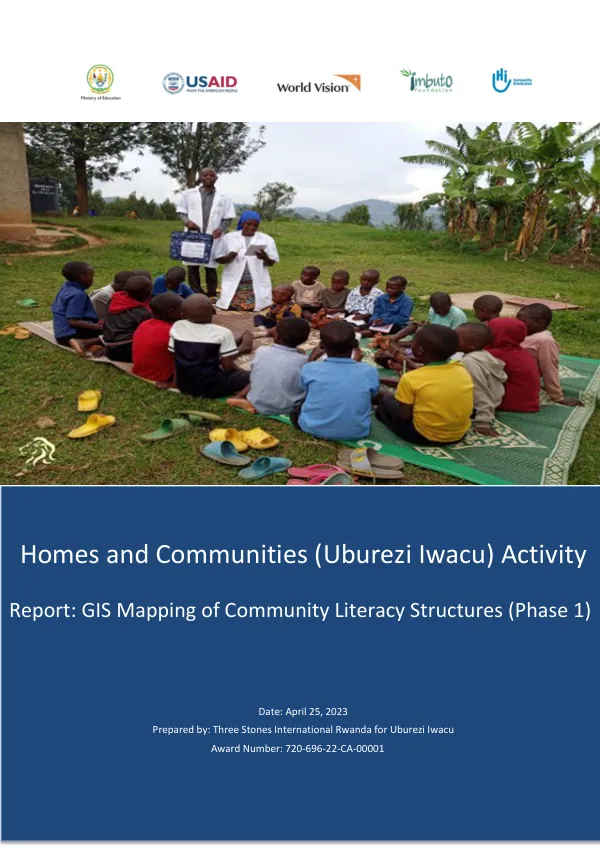
The Homes and Communities (Uburezi Iwacu) Activity Report: GIS Mapping of Community Literacy Structures (Phase 1) was prepared by Three Stones International Rwanda for Uburezi Iwacu, with funding from the United States Agency for International Development (USAID).
2023 · 79 pages
Sign in to readA free account is required to download.
Abstract
The report focuses on the geographic information system (GIS) mapping of community literacy structures in Rwanda. The GIS system used in this project is based on the Environmental System Research Institute (ESRI) platform. The survey tools employed included a participatory GIS mapping approach, which involved community members in the data collection process. A total of 1,234 community literacy structures were mapped, including community libraries, disability centers, early childhood development (ECD) centers, and reading clubs. The report presents findings on the distribution of community libraries across Rwanda, with a focus on the number of libraries, user demographics, and book collections. The data indicates that community libraries are more prevalent in urban areas, with a higher concentration of libraries in Kigali City. The libraries serve a diverse user base, with a significant proportion of users being children and women. The report also presents findings on disability centers, including the number of centers, user demographics, and services offered. The data indicates that disability centers are more prevalent in rural areas, with a higher concentration of centers in the Eastern Province. The centers provide a range of services, including therapy, education, and social support. In addition to community libraries and disability centers, the report presents findings on ECD centers, including the number of centers, user demographics, and services offered. The data indicates that ECD centers are more prevalent in urban areas, with a higher concentration of centers in Kigali City. The centers provide a range of services, including education, nutrition, and health support. The report also presents findings on reading clubs, including the number of clubs, user demographics, and activities organized. The data indicates that reading clubs are more prevalent in urban areas, with a higher concentration of clubs in Kigali City. The clubs provide a range of activities, including book clubs, literacy programs, and cultural events. The report concludes that the GIS mapping of community literacy structures has provided valuable insights into the distribution and characteristics of these structures across Rwanda. The findings highlight the importance of community libraries, disability centers, ECD centers, and reading clubs in promoting literacy and social development in Rwanda. The report recommends that future initiatives focus on strengthening these structures, particularly in rural areas, to improve access to education and social services for marginalized communities. The report includes a range of annexes, including survey tools, maps, and user guides, which provide additional information on the methodology and findings of the project. The annexes include a user guide for Google MyMaps, which provides instructions on how to use the platform for data visualization and mapping. The report also includes a range of tables and figures, which provide additional information on the data collected during the project. The tables and figures include data on community literacy structures, user demographics, and services offered, as well as data on funding providers and support organizations. Overall, the Homes and Communities (Uburezi Iwacu) Activity Report: GIS Mapping of Community Literacy Structures (Phase 1) provides valuable insights into the distribution and characteristics of community literacy structures in Rwanda. The report highlights the importance of these structures in promoting literacy and social development, and recommends that future initiatives focus on strengthening these structures to improve access to education and social services for marginalized communities.