USAID DEC
Promoting Clinical Reasoning using the ICF Framework for Continuing Education Development in Rwanda
Sign inFLORIDA INTERNATIONAL UNIVERSITY
Promoting Clinical Reasoning using the ICF Framework for Continuing Education Development in Rwanda
The Professional Development Course for Physical Therapists in Rwanda was a 60-hour program designed to promote clinical reasoning skills using the International Classification of Function, Disability and Health (ICF) framework.
2015 · 1 pages
Sign in to readA free account is required to download.
Abstract
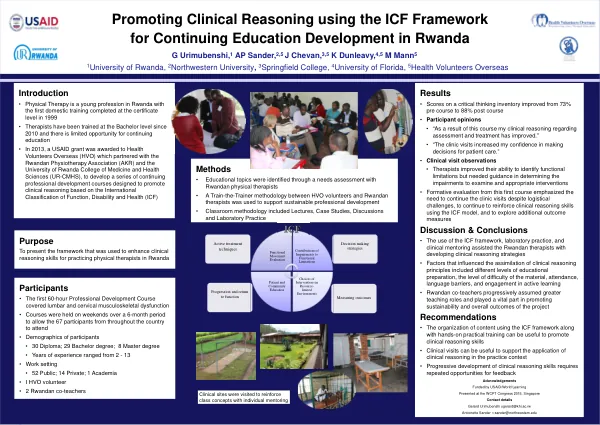
The course was conducted over a 6-month period, with weekend sessions allowing 67 participants from throughout the country to attend. Participants included physical therapists with varying levels of education and experience, with 30 holding a diploma, 29 a bachelor's degree, and 8 a master's degree. Their years of experience ranged from 2 to 13, and they worked in public, private, and academic settings. The course was developed in response to the limited opportunities for continuing education in physical therapy in Rwanda. Physical therapy is a young profession in the country, with the first domestic training completed at the certificate level in 1999 and bachelor's level training introduced in 2010. A USAID grant was awarded to Health Volunteers Overseas (HVO) in 2013 to partner with the Rwandan Physiotherapy Association (AKR) and the University of Rwanda College of Medicine and Health Sciences (UR-CMHS) to develop a series of continuing professional development courses. The course used a Train-the-Trainer methodology, where HVO volunteers and Rwandan therapists worked together to support sustainable professional development. Classroom methodology included lectures, case studies, discussions, and laboratory practice. The course focused on several key topics, including functional movement evaluation, contributions of impairments to functional limitations, choices of interventions in resource-limited environments, patient and community education, progression and return to function, measuring outcomes, active treatment techniques, and decision-making strategies. The results of the course showed significant improvement in critical thinking skills, with scores on a critical thinking inventory increasing from 73% pre-course to 88% post-course. Participants reported improved clinical reasoning and confidence in making decisions for patient care. Clinical visit observations also showed that therapists improved their ability to identify functional limitations, but needed guidance in determining the impairments to examine and appropriate interventions. The use of the ICF framework, laboratory practice, and clinical mentoring was found to be effective in assisting Rwandan therapists with developing clinical reasoning strategies. Factors that influenced the assimilation of clinical reasoning principles included different levels of educational preparation, the level of difficulty of the material, attendance, language barriers, and engagement in active learning. Rwandan co-teachers played a vital part in promoting sustainability and overall outcomes of the project. The organization of content using the ICF framework along with hands-on practical training was found to be useful in promoting clinical reasoning skills. Clinical visits were also useful in supporting the application of clinical reasoning in the practice context. Progressive development of clinical reasoning skills requires repeated opportunities for feedback.