USAID. MISSION TO HONDURAS
Honduran Council for Human Resources Development
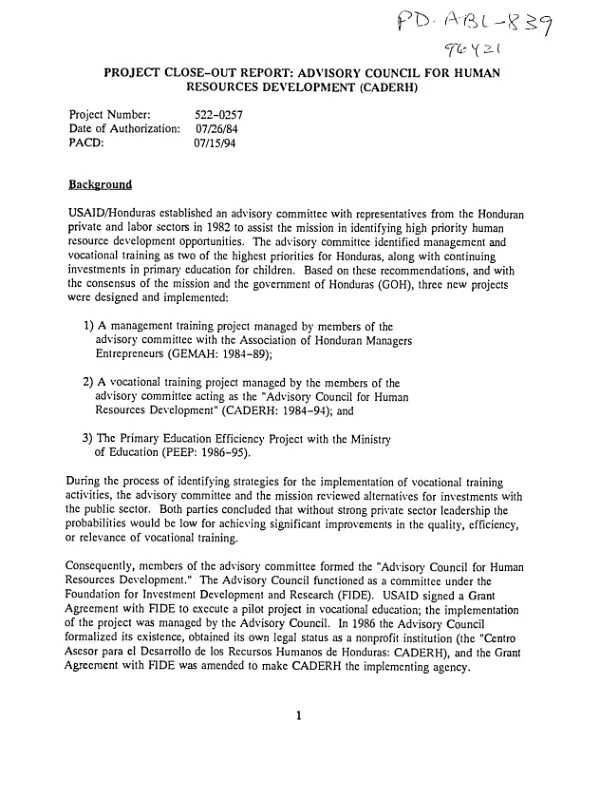
Summarizes evaluation (PD-ABA-060) of a project to improve the quality and relevance of vocational/technical education for meeting private sector training needs in Honduras and to achieve the economic and technical self-sustainabllity of the implementing institution, the Honduran Council for Human Resources Development (CADERH), by the PACD of 5/92.
1989
Sign in to readA free account is required to download.

Abstract
This mid-term evaluation was conducted on the basis of a review of project documents, interviews with project personnel and private sector representatives, and the direct observation and evaluation of CADERH services and products. The purpose was to evaluate CADERH"s performance during the first 2 years of a 5-year project amendment (1987-1992) in: (1) improving the quality and relevance of vocational/technical education for private sector training needs; and (2) reaching financial and technical self-sustainability as an institution. The major findings and conclusions are as follows. (1) Leadership is excellent but organizational flexibility is being reduced by tensions between the project"s development goals and the demands for economic self-sustainability. (2) Changes are being made in the training system, and the basic strategy and rational for improving vocational/technical instruction are valid and could be used by other Honduran and Latin American training institutions for achieving higher degrees of relevance, quality, and cost effectiveness. (3) Industry-specific training has not been implemented as activities are one year behind schedule for various reasons; training needs analyses are revealing needed changes in industry. (4) CADERH is likely to survive as an institution but cannot continue its optimum development impact activities with less privileged sectors of society without an endowment or other sources of income. (5) Technical capabilities are satisfactory, although they could be improved in competency testing and training needs analyses. Four lessons were learned. (1) Required changes in policies which have a negative effect on project implementation should be accompanied by parallel adjustments for facilitating project implementation. (2) Goals for economic self-sustainability cause institutions to offer services to more privileged sectors of society. If development impact for less privileged sectors is to be maintained, appropriate sources of funding must be provided. (3) Validated competency exams should be in place before developing competency-based instructional materials. (4) Successful TA advisors must be culturally sensitive, attending to client"s needs and desires, rather than offering prepackaged solutions and should work with clients, not just tell clients what to do. (Author abstract)
Related documents