MINISTRY OF THE ENVIRONMENT
Human Rights Compass: May - June 2014
The USAID Human Rights Program in Colombia, supported by the Human Rights Promotion III (HRP III) initiative, has been working to promote human rights and peace in Afro-Colombian and indigenous communities.
2014 · 4 pages
Sign in to readA free account is required to download.
Abstract
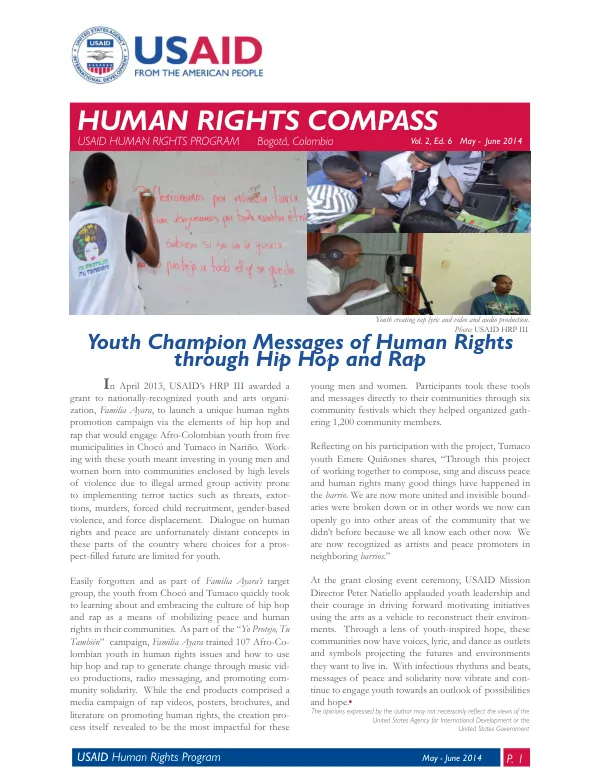
In the Chocó and Tumaco regions, a unique human rights promotion campaign was launched in 2013, utilizing hip hop and rap music to engage youth in promoting peace and human rights. The campaign, titled "Yo Protejo, Tu También" (I Protect, You Also), trained 107 Afro-Colombian youth in human rights issues and how to use music to generate change. The campaign's focus on youth empowerment and community engagement has been successful in promoting peace and human rights in the region. Participants in the campaign have reported increased unity and a sense of community, with many expressing a newfound sense of purpose and identity. The campaign's use of music and art has also provided a platform for youth to express themselves and share their experiences, helping to break down social and cultural barriers. In addition to the hip hop and rap campaign, the USAID Human Rights Program has also been working to advance land restitution processes in the Bajo Cauca region of Antioquia. The program has provided support for a First Regional Land and Forest Reserve Forum, which brought together key government players, community leaders, and other stakeholders to discuss the challenges and opportunities related to land restitution. The forum highlighted the need for inter-institutional coordination and response to advance land restitution processes, and participants committed to scheduling future forums with greater national government representation. The program has also been working to address the issue of illegal mining in the Cauca region. The rise of illegal mining has led to violence, displacement, and environmental degradation, and has had a disproportionate impact on Afro-Colombian and indigenous communities. The program has supported public hearings and community meetings to raise awareness about the issue and to promote dialogue and cooperation among stakeholders. The program has also been working to support the development of alternative livelihoods and economic opportunities for communities affected by illegal mining. In the context of these efforts, the USAID Human Rights Program has been working to support the development of institutional capacity and coordination among government agencies and community organizations. This includes providing technical assistance and training to support the implementation of laws and policies related to human rights and land restitution, as well as facilitating dialogue and cooperation among stakeholders. The program's work in Colombia has been guided by a commitment to promoting human rights and peace, and to supporting the development of sustainable and equitable solutions to the challenges faced by Afro-Colombian and indigenous communities. Through its work, the program aims to contribute to a more just and equitable society in Colombia, and to promote the rights and dignity of all individuals and communities.
Related documents