CHEMONICS
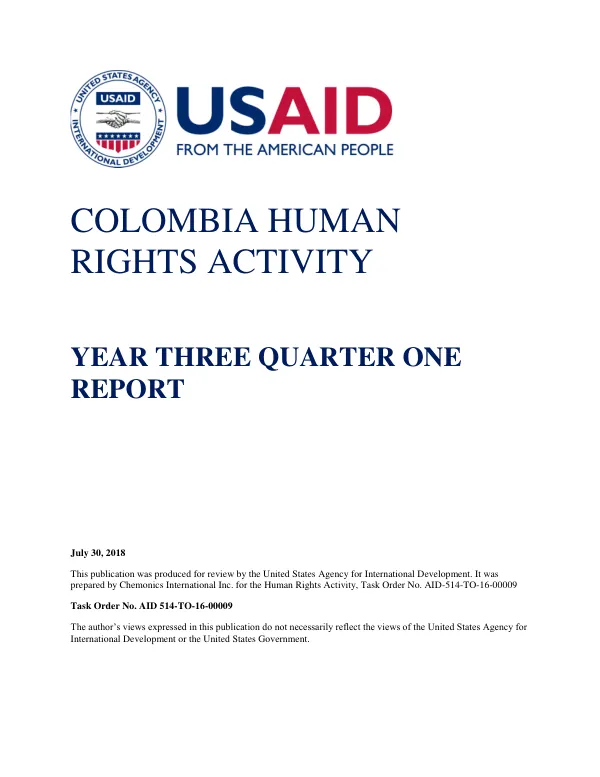
Year Three Quarter One Report: Colombia Human Rights Activity
Colombia's Human Rights Activity continued to provide technical support and guidance to key stakeholders to improve the country's human rights situation during the post-accord phase.
2018 · 36 pages
Sign in to readA free account is required to download.
Abstract
The Human Rights Activity (HRA) is a USAID-funded program that aims to strengthen the capacity of Colombian institutions and civil society to promote and protect human rights. During the quarter, Colombia held its first presidential election in over 50 years, with far-right candidate Iván Duque winning the election by a significant margin. The election was marked by a high turnout rate, with 53% of registered voters casting their ballots. The election also remained one of the safest in Colombia's history, with no notable incidents reported. However, the quarter was also marked by a catastrophic malfunction of the Hidroituango Dam, which resulted in massive flooding and the evacuation of 600 people to temporary shelters. The disaster displaced several thousand local residents and threatened the safety of eight surrounding municipalities, including HRA's municipalities of Valdivia, Tarazá, Cáceres, Caucasia, and Nechí. As a result, HRA's regional advisors were provisionally relocated, and several scheduled activities were postponed or cancelled in the sub-region. Colombia's human rights defenders' crisis also continued to worsen during the quarter, with 48 human rights defenders and other social leaders killed, bringing the year-to-date total to 123. This systematic loss of life, predominantly led by illegal armed groups and other peacebuilding spoilers, continues to undermine the implementation of Colombia's peace accord. To address this crisis, HRA remained committed to implementing its human rights defender strategy, including efforts to strengthen prevention and self-protection strategies targeting high-risk communities in sub-regions such as Bajo Cauca, Antioquia, and northern Cauca. In March, HRA organized and facilitated a special two-day national forum to bring together key stakeholders to address the impact of ethnic human rights defenders and other social leaders in the regions. The forum provided a valuable platform for ethnic leaders to develop recommendations and proposals, which were then discussed in a dialogue with government officials. Government representation included the Inspector General, the Vice-Ombudsman, the Vice-Minister of Defense, Minister of Interior, the National Protection Unit (NPU) director, and a representative of the Office of the Presidential Advisor for Human Rights (CPDH). HRA also made progress in advancing activities related to developing and providing self-protection tools and techniques for at-risk communities throughout HRA's municipalities. This progress was achieved by working alongside public sector partners such as the Police Unit for Peacebuilding (UNIPEP) and local authorities in Briceño and Caceres, Antioquia to strengthen institutional capacity and promote community-led initiatives. The Human Rights Activity continued to work closely with other USAID programs, including the Regional Governance Activity (RGA) and the Justice for a Sustainable Peace (JSP) program, to advance the implementation of Colombia's peace accord and promote human rights. HRA also maintained a strong focus on monitoring and evaluation, with a quarterly financial report and indicator progress report submitted to USAID. Overall, the Human Rights Activity continued to play a critical role in promoting and protecting human rights in Colombia, despite the challenges posed by the country's post-accord phase. The program's commitment to strengthening the capacity of Colombian institutions and civil society to promote and protect human rights remains unwavering, and its efforts will continue to be essential in advancing the implementation of Colombia's peace accord.
Related documents