USAID
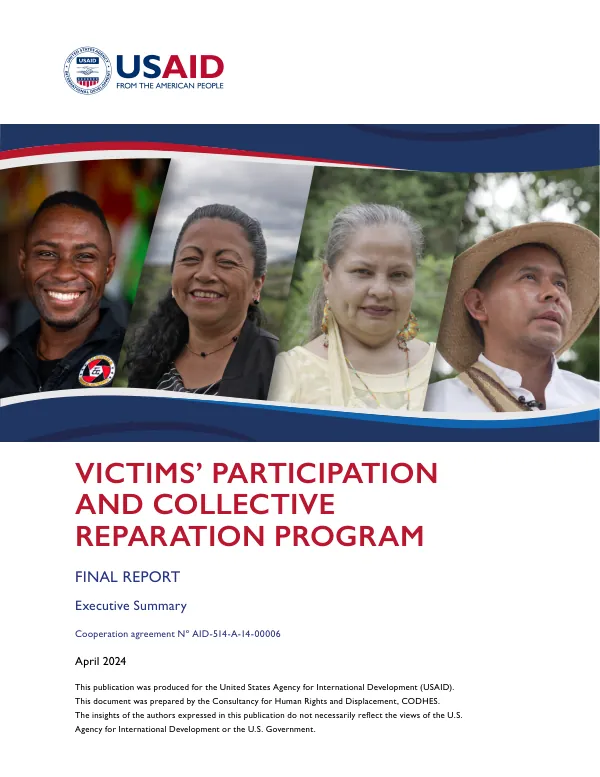
Victims’ Participation and Collective Reparation Program FINAL REPORT
The internal armed conflict in Colombia has left more than nine million victims, of whom 89% have been forcibly displaced.
2024 · 63 pages
Sign in to readA free account is required to download.
Abstract
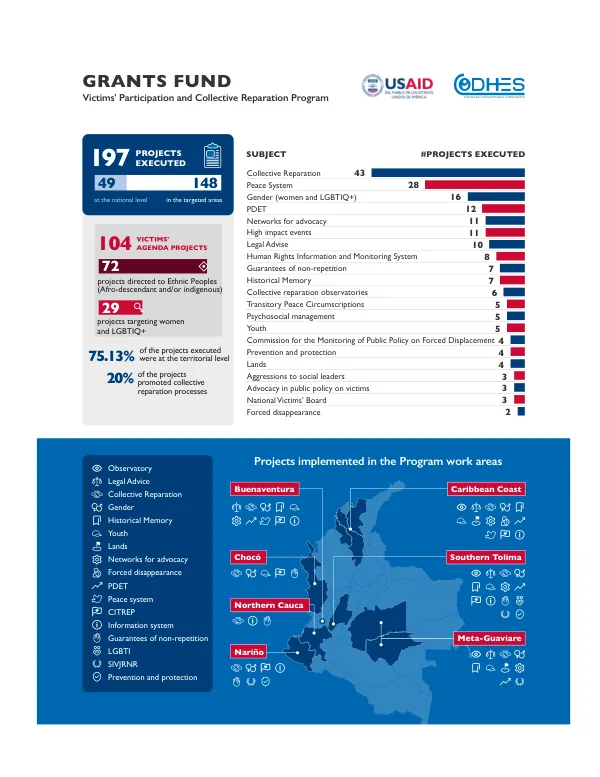
In a context of conflict, where a large part of the victim population has experienced forced displacement, the Constitutional Court decreed an unconstitutional state of affairs through Ruling T-025 of 2004, due to the limited progress made by the State in addressing the magnitude and impact of this gross human rights violation on the victims. Subsequently, Law 1448 of 2011 - the Victims' Law - defined the public policy to guarantee the rights of victims, but this has been implemented with many difficulties without yet achieving the established goals. In 2016, the Government of Colombia signed the Final Agreement for the Termination of the Conflict and the Construction of a Stable and Lasting Peace, which established new mechanisms and created a new institutional framework through the Comprehensive System for Peace (SIP), which seeks to guarantee the rights of the victims of the conflict. The Victims Participation and Collective Reparation Program (hereinafter, the Program) funded by the United States Agency for International Development (USAID) began its activities in 2014 with two main objectives: to promote the participation of civil society in the implementation of Law 1448 of 2011 and to influence the formulation of public policies that contribute to guaranteeing the rights of victims in the framework of peace and reconciliation processes. The specific objectives, actions, and territorial coverage of the Program varied over the last decade according to the political and social transformations of the country. The Program aimed to strengthen the organizational and operational capacities of victims' and civil society organizations, support the initiatives of victims' organizations and civil society through a grants fund, promote effective participation in collective reparation processes, territorialize the victims' law, the Peace Agreement, and the related policies thereof, strengthen the institutional capacities of victims' organizations to advocate, monitor, evaluate, and follow up on the SIP, influence the processes of legal and/or jurisprudence production to implement the Peace Agreement, promote prevention and protection mechanisms to guarantee the rights to life, integrity, and security of social leaders and human rights defenders, victims, and communities, and promote the guarantee of victims' rights based on the effective application of the mandates of the Constitutional Court derived from Ruling T-025 of 2004, and the adaptation, extension of the validity, and compliance with Law 1448 of 2011 and its law decrees for victims of ethnic groups. A strategic alliance was established between the Consultancy for Human Rights and Displacement (CODHES), Management Sciences for Development Consulting (MSD), and Corporación Opción Legal (Legal Option Corporation) for the development of the Program. The intervention areas of the Program included 21 municipalities affected by the armed conflict, but it has generated indirect impacts in 87 municipalities in seven PDET subregions. The Program conceived participation as a process that empowers individuals and groups to influence the activities that affect their lives, and citizen participation was understood as a right linked to democratic strengthening and the construction of governance that allows for influence in state and non-state spheres. The Program aimed to contribute to the victims' right to participation by strengthening social and community organizations. To this end, the Program supported the initiatives of victims' organizations and civil society through a grants fund, promoted effective participation in collective reparation processes, and territorialized the victims' law, the Peace Agreement, and the related policies thereof. The Program also strengthened the institutional capacities of victims' organizations to advocate, monitor, evaluate, and follow up on the SIP, influenced the processes of legal and/or jurisprudence production to implement the Peace Agreement, and promoted prevention and protection mechanisms to guarantee the rights to life, integrity, and security of social leaders and human rights defenders, victims, and communities. The Program's efforts focused on strengthening social and community organizations, and this executive report highlights the progress made in strengthening the organizations and in the recognition of their role by the authorities. The Program's activities were implemented in collaboration with the National Victims' Effective Participation Board, the National Board of Ethnic Actors PDET, and the Political Secretariat of the Subjects of Collective Reparation. The Program's legal advocacy strategies covered the entire country, as they were implemented in the Congress and the Constitutional Court. The Program's approach considered participation as a right in itself and as a means to materialize other rights. The Program's efforts aimed to promote the effective enjoyment of rights by victims and civil society organizations, and to influence the formulation of public policies that contribute to guaranteeing the rights of victims in the framework of peace and reconciliation processes. The Program's activities were designed to contribute to the victims' right to participation, and to promote the guarantee of victims' rights based on the effective application of the mandates of the Constitutional Court derived from Ruling T-025 of 2004, and the adaptation, extension of the validity, and compliance with Law 1448 of 2011 and its law decrees for victims of ethnic groups.