USAID/FFP
Humanitarian Assistance in Review: Latin America and the Caribbean | FY 2003 – 2012
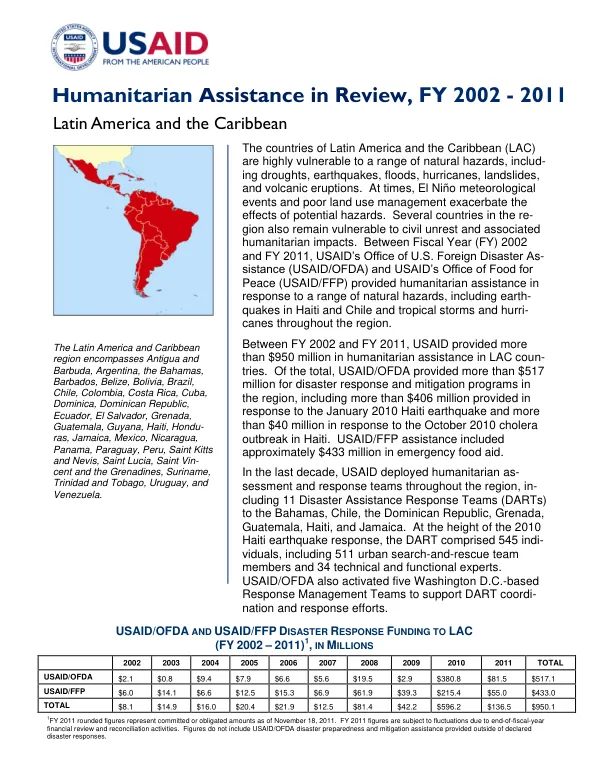
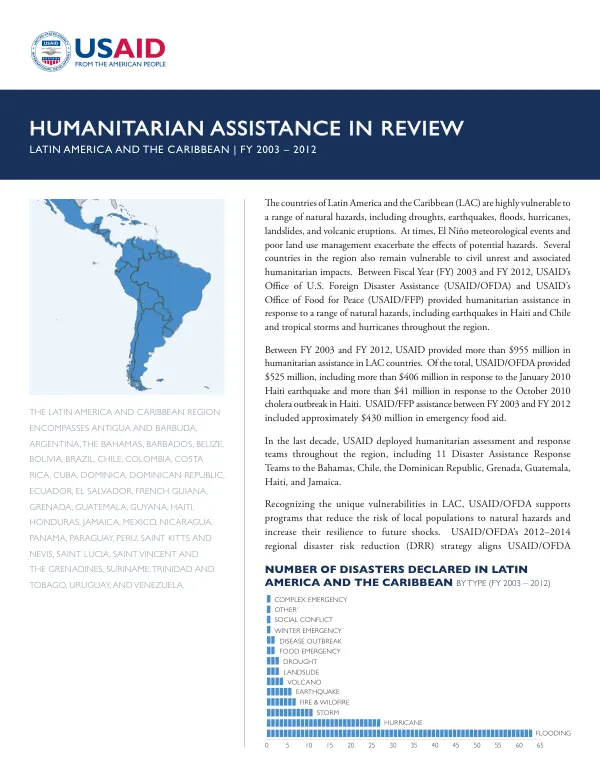
The Latin America and Caribbean region encompasses a diverse range of countries, including Antigua and Barbuda, Argentina, the Bahamas, Barbados, Belize, Bolivia, Brazil, Chile, Colombia, Costa Rica, Cuba, Dominica, Dominican Republic, Ecuador, El Salvador, French Guiana, Grenada, Guatemala, Guyana, Haiti, Honduras, Jamaica, Mexico, Nicaragua, Panama, Paraguay, Peru, Saint Kitts and Nevis, Saint Lucia, Saint Vincent and the Grenadines, Suriname, Trinidad and Tobago, Uruguay, and Venezuela.
2012 · 2 pages
Sign in to readA free account is required to download.
Abstract
This region is highly vulnerable to a range of natural hazards, including droughts, earthquakes, floods, hurricanes, landslides, and volcanic eruptions. Between Fiscal Year 2003 and Fiscal Year 2012, USAID's Office of U.S. Foreign Disaster Assistance (USAID/OFDA) and USAID's Office of Food for Peace (USAID/FFP) provided humanitarian assistance in response to a range of natural hazards, including earthquakes in Haiti and Chile and tropical storms and hurricanes throughout the region. The total amount of humanitarian assistance provided by USAID in LAC countries during this period exceeded $955 million. USAID/OFDA provided $525 million, including more than $406 million in response to the January 2010 Haiti earthquake and more than $41 million in response to the October 2010 cholera outbreak in Haiti. USAID/OFDA's disaster risk reduction (DRR) strategy in the LAC region focuses on reducing the risk of local populations to natural hazards and increasing their resilience to future shocks. The strategy includes training and technical assistance to local, regional, and national emergency management systems through the Regional Disaster Assistance Program (RDAP); earthquake monitoring assistance, in collaboration with the U.S. Geological Survey; and activities to increase preparedness and response capabilities in urban areas. USAID/OFDA prioritizes hurricane preparedness and capacity building activities in the LAC region throughout the year to enable rapid response to humanitarian needs during hurricane season. USAID/FFP works to save lives and reduce food insecurity in times of crisis and situations of chronic food insecurity through emergency and development food assistance programs. USAID/FFP emergency food assistance includes both in-kind food aid and cash-based assistance in the form of local and regional procurement of food commodities, cash transfers, and food vouchers, where market conditions allow. USAID/OFDA and USAID/FFP have agreements with air charter services for transportation of personnel and relief supplies to storm-affected areas, if needed, and stockpiled emergency relief supplies are available for rapid shipment throughout the LAC region from the USAID/OFDA warehouse in Miami, Florida. The LAC region experienced a significant number of disasters between FY 2003 and FY 2012, including droughts, storms, hurricanes, landslides, disease outbreaks, social conflicts, food emergencies, winter emergencies, volcanic eruptions, earthquakes, flooding, and complex emergencies. USAID/OFDA's humanitarian assistance in the LAC region during this period focused on providing emergency relief supplies, food aid, and shelter to affected populations. The region's unique vulnerabilities to natural hazards and the need for disaster risk reduction and management efforts are key considerations for USAID's humanitarian assistance programs in the LAC region.