USAID DEC
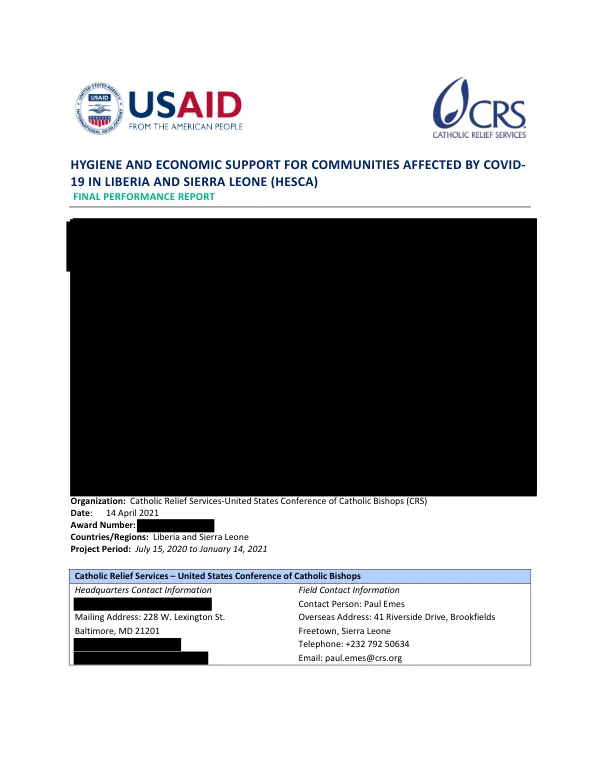
Hygiene and Economic Support for Communities Affected by COVID-19 in Liberia and Sierra Leone (HESCA) Final Performance Report
Sign inUSAID DEC
Hygiene and Economic Support for Communities Affected by COVID-19 in Liberia and Sierra Leone (HESCA) Final Performance Report
The Hygiene and Economic Support to Communities Affected by COVID-19 in Liberia and Sierra Leone (HESCA) project was a six-month USAID/BHA-funded initiative implemented by Catholic Relief Services (CRS) in collaboration with the Governments of Sierra Leone and Liberia, and local implementing partners.
2021 · 16 pages
Sign in to readA free account is required to download.
Abstract
The project aimed to support vulnerable people and communities in Sierra Leone and Liberia to adopt key preventative behaviors to protect themselves and others from COVID-19 and assist vulnerable households affected by COVID-19 to purchase basic and essential items to meet their most urgent needs through multipurpose cash assistance (MPCA). The project reached 174,625 people in vulnerable communities in the Western Area Rural, BO, Kenema, and Bombali districts in Sierra Leone and Rural Montserrado, Bong, and Margibi Counties in Liberia. The project's two key interventions were Water Sanitation & Hygiene and COVID-19 prevention support, and economic support through multi-purpose cash transfer to registered vulnerable households. The project used the Water Sanitation and Hygiene in Emergency (WASH-Em) approach and aligned with the Water, Sanitation, and Hygiene (WASH) Policies to ensure alignment with government policy. During the project period, CRS implemented projects within Western Area Rural, Bo, Kenema, and Bombali Districts in Sierra Leone and Rural Montserrado, Bong, and Margibi Counties in Liberia. The project's local implementing partners, with support from the national health and emergency units, selected the project communities based on COVID-19 cases and resulting economic impact from government-controlled movement restrictions. The project leveraged on coordination efforts with the Cash Technical Working Group in determining and aligning with government and sector players in limiting duplications, determining the beneficiaries, and cash amount to be accorded to each household. The project activities and accomplishments included the adoption of the WASH in Emergencies (Wash'Em) training guide and COVID-19 prevention and Hygiene promotion flip book, training of over 150 project staff and volunteers on hygiene promotion messaging and COVID-19 prevention campaigns, hygiene promotion and COVID-19 prevention roll out benefiting a total of 174,625 individuals, distribution and installation of 975 hand washing stations and soap, rehabilitation and protection of 22 water points, provision of multipurpose cash transfer to 4,902 households, and supportive supervision, monitoring, and evaluation of activities at the seven targeted districts and counties across Sierra Leone and Liberia. The project used a multipurpose cash transfer approach to support vulnerable households affected by COVID-19 to purchase basic and essential items to meet their most urgent needs. The cash transfer was provided to households in the form of a direct cash transfer, with the amount varying depending on the household size. The project also provided hygiene promotion messages and COVID-19 prevention support to vulnerable people and communities in Sierra Leone and Liberia. The project's goal was to support vulnerable people to survive COVID-19 with dignity in Sierra Leone and Liberia. The project's impact was significant, with a total of 174,625 people reached in vulnerable communities in Sierra Leone and Liberia. The project's activities and accomplishments included the distribution and installation of 975 hand washing stations and soap, rehabilitation and protection of 22 water points, provision of multipurpose cash transfer to 4,902 households, and supportive supervision, monitoring, and evaluation of activities at the seven targeted districts and counties across Sierra Leone and Liberia. The project's use of a multipurpose cash transfer approach and hygiene promotion messages and COVID-19 prevention support helped to support vulnerable people and communities in Sierra Leone and Liberia to adopt key preventative behaviors to protect themselves and others from COVID-19.
Related documents