USAID DEC
Identifying People Living with HIV and Improving ART Coverage in USAID-Supported States in Nigeria
Sign inJEMBI HEALTH SYSTEMS, SA
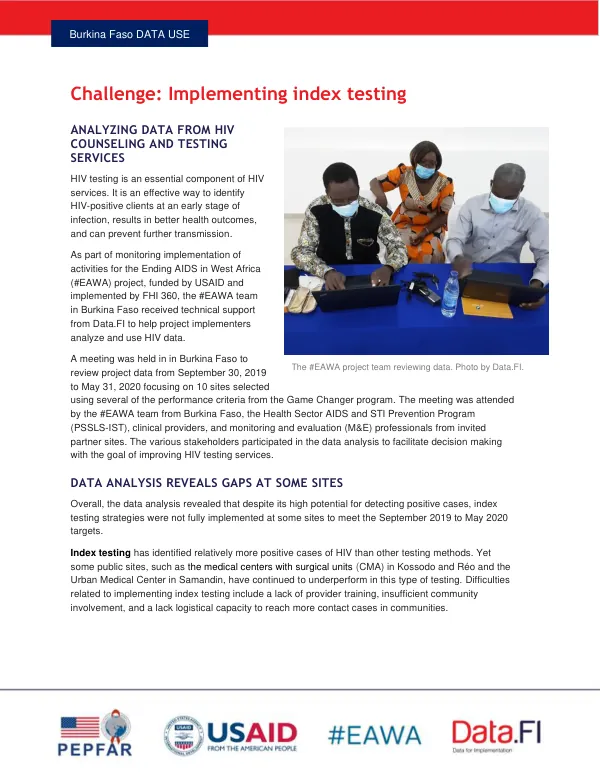
Identifying People Living with HIV and Improving ART Coverage in USAID-Supported States in Nigeria
The Joint United Nations Programme on HIV/AIDS (UNAIDS) issued a fast-track strategy to reach 95-95-95 goals by 2030, which includes 95 percent of people living with HIV (PLHIV) knowing their HIV status, 95 percent of people aware of their status being on treatment, and 95 percent of people on treatment having suppressed viral load.
2021 · 4 pages
Sign in to readA free account is required to download.
Abstract
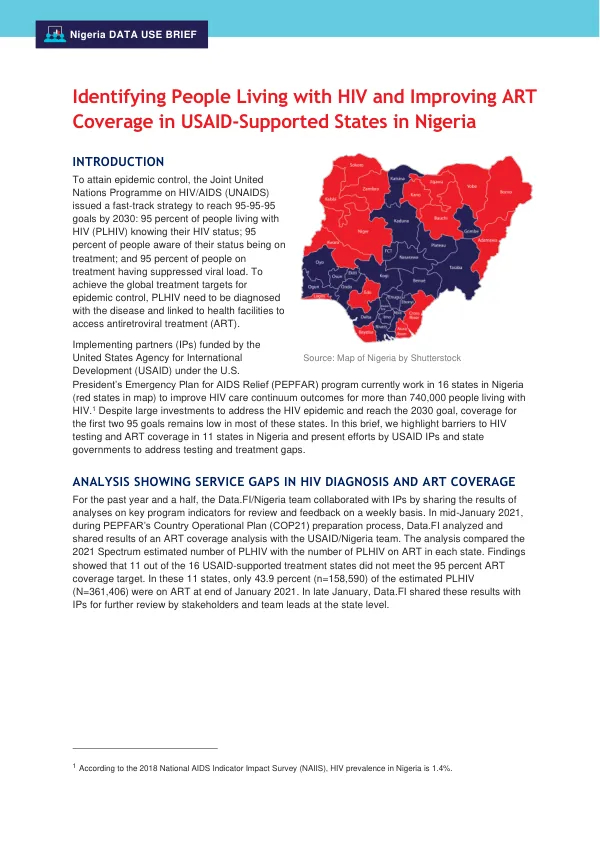
To achieve these global treatment targets for epidemic control, PLHIV need to be diagnosed with the disease and linked to health facilities to access antiretroviral treatment (ART). Implementing partners (IPs) funded by the United States Agency for International Development (USAID) under the U.S. President's Emergency Plan for AIDS Relief (PEPFAR) program work in 16 states in Nigeria to improve HIV care continuum outcomes for more than 740,000 people living with HIV. Despite large investments to address the HIV epidemic and reach the 2030 goal, coverage for the first two 95 goals remains low in most of these states. In 11 states in Nigeria, barriers to HIV testing and ART coverage were identified, including a low understanding among service providers of how to provide index testing services, a low partner elicitation ratio by clients during index testing, and various logistical barriers that limit service provision to communities living in hard-to-reach areas. To address these gaps, stakeholders agreed on several strategies, including ensuring that case finding is optimized across all implemented states through capacity strengthening and mentoring services providers, deploying innovative technology such as geographic information systems, and engaging community health extension workers and setting up mobile units for testing and linking HIV-positive clients to ART in hard-to-reach communities. Additionally, a social media strategy was deployed to reach more key population (KP) networks with HIV testing services, and advocacy visits were conducted to stakeholders at different levels of operation to address undue harassment of KPs. After eight weeks of implementing these strategies, a comparative analysis of baseline ART coverage with the end line ART coverage showed that 49.7 percent of clients were on ART at end line, which is a 5.8 percentage points increase in ART coverage compared to baseline, with 20,858 more clients on treatment. To ensure improvement is sustained, stakeholders will continue to scale up index testing services across all health facilities and build the capacity of healthcare workers to provide those services. They have also committed to ensuring continuous collaboration with state actors to create an enabling environment for HIV interventions, especially interventions for KPs faced with discrimination and harassment by government law enforcement agencies. The Data for Implementation (Data.FI) team, a five-year cooperative agreement funded by the U.S. President's Emergency Plan for AIDS Relief through the U.S. Agency for International Development, implemented these strategies in partnership with several organizations, including Palladium, JSI Research & Training Institute, Johns Hopkins University, and Right to Care. The information provided in this publication is not official U.S. Government information and does not necessarily reflect the views or positions of the U.S. President's Emergency Plan for AIDS Relief, U.S. Agency for International Development, or the United States Government.
Related documents