USAID DEC
SIMS Assessments: What they are and what they contribute to the HIV response in Nigeria
Sign inDT GLOBAL
SIMS Assessments: What they are and what they contribute to the HIV response in Nigeria
The Data for Implementation (Data.FI) project in Nigeria works with the United States Agency for International Development (USAID) to accelerate and sustain access to high-quality data to expedite HIV epidemic control and maintenance.
2023 · 4 pages
Sign in to readA free account is required to download.
Abstract
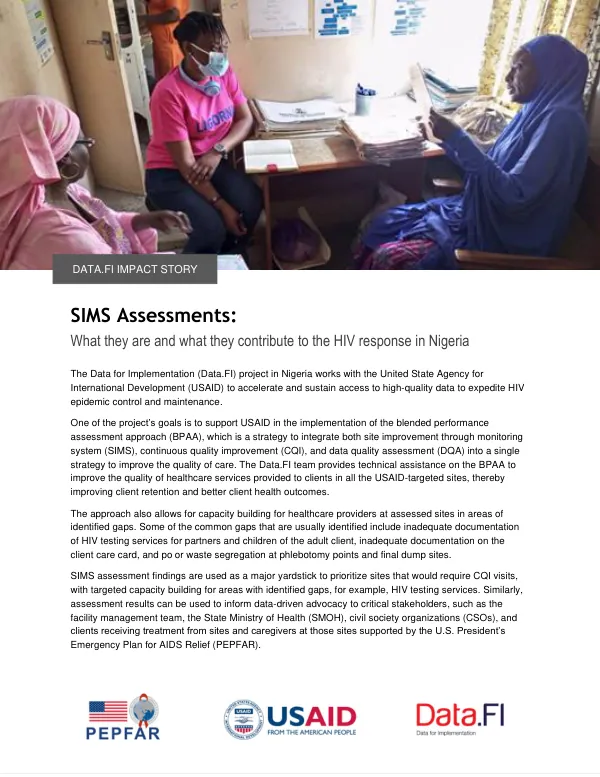
One of the project's goals is to support USAID in the implementation of the blended performance assessment approach (BPAA), which integrates site improvement through monitoring system (SIMS), continuous quality improvement (CQI), and data quality assessment (DQA) into a single strategy to improve the quality of care. The BPAA involves technical assistance on SIMS to improve the quality of healthcare services provided to clients in all USAID-targeted sites, thereby improving client retention and better client health outcomes. SIMS assessment findings are used as a major yardstick to prioritize sites that would require CQI visits, with targeted capacity building for areas with identified gaps. Assessment results can also be used to inform data-driven advocacy to critical stakeholders, such as facility management teams, State Ministries of Health, civil society organizations, and clients receiving treatment from sites and caregivers at those sites supported by the U.S. President's Emergency Plan for AIDS Relief (PEPFAR). SIMS assessments in Nigeria are conducted by Data.FI in health facilities supported with funding from PEPFAR through USAID. Facilities provide a range of HIV-related services, including HIV care and treatment for the general population, key populations, and orphan and vulnerable children (OVC). The assessments examine service delivery areas such as provider-initiated testing and counseling (PITC) at directly observed therapy (DOTs) and labor and delivery units, HIV care and treatment for adults on antiretroviral treatment (ART) and for key populations, HIV-infected OVC, and prevention of mother-to-child transmission of HIV/AIDS (PMTCT) clients. A SIMS assessment involves three stages: facility in-brief, assessment process, and facility debriefs, in which the team shares key findings, including best practices and gaps noted in each assessed site. Each of these assessment processes involves on-the-job capacity strengthening for facility and implementing partner (IP) teams and aligning teams with PEPFAR's standards for service delivery. Data from SIMS assessments are analyzed and shared with IP and USAID's Agreement Officer's Representative and other USAID technical teams, fostering collaborative learning about the results and promoting leadership for high-quality service delivery and client-centered services for beneficiaries of PEPFAR-supported services. In the fiscal year 2022 (FY22), Data.FI conducted a total of 78 SIMS assessments across 48 sites in ten states, working in collaboration with six USAID IPs. To date in FY23, Data.FI has supported SIMS assessments in 17 sites across four states. Three impact stories have been developed to showcase improvements in three facilities assessed by Data.FI, demonstrating improvements in service quality for viral load assessments, provision of enhanced adherence counseling, and involvement of PEPFAR beneficiaries in quality improvement processes. These improvements were achieved within six months of comprehensive and follow-up SIMS assessments, with assessed sites using remediation plans, root cause analysis, comprehensive folder audits, onsite capacity building sessions, and data updates to address identified gaps.