USAID DEC
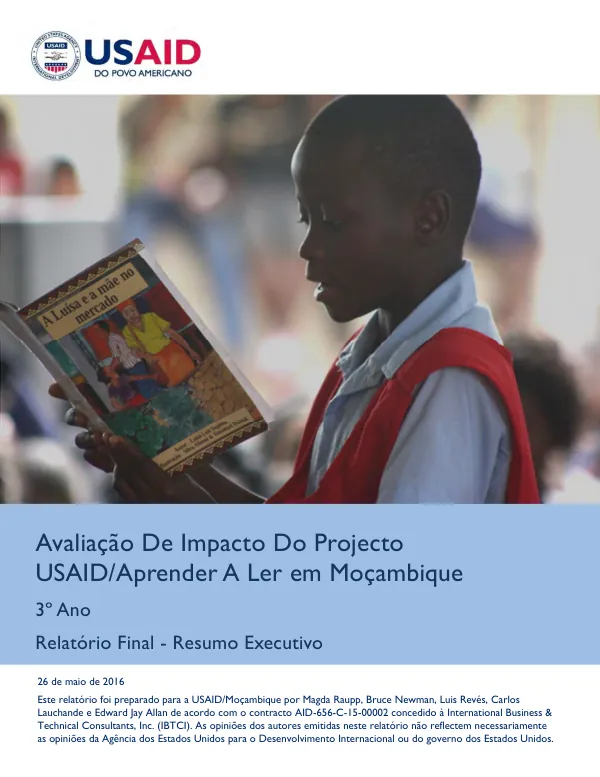
Impact Evaluation for the USAID/Aprender a Ler Project in Mozambique: Baseline Report
Sign inINTERNATIONAL BUSINESS AND TECHNICAL CONSULTANTS, INC.
Impact Evaluation for the USAID/Aprender a Ler Project in Mozambique: Baseline Report
The USAID/Aprender a Ler Early Grade Reading Project in Mozambique began in 2013 with the goal of improving reading skills among second and third-grade students.
2013 · 180 pages
Sign in to readA free account is required to download.
Abstract
The project focused on 180 schools located in the economic corridors of the Nampula and Zambézia provinces. Baseline data collection was conducted in February/March 2013, at the beginning of the 2013 school year, to assess the current situation in participating schools and inform project implementation. Assessments of student learning in the primary grades, such as the Early Grade Reading Assessment (EGRA), were used to determine whether children are developing fundamental skills upon which all other literacy skills build. The EGRA scores reflect the performance of 1,798 second and 1,800 third graders at the beginning of second and third grades, respectively. The School Management Assessment (SMA) instrument provided a multifaceted view of school and classroom characteristics traditionally associated with student performance. Mozambique's public education system has faced significant challenges, including rapid expansion of access to primary schooling, insufficient school buildings, and a shortage of qualified teachers. The education system has had to adapt to the influx of new students, often resulting in double and triple shift schools, and the hiring of teachers and directors who may not have the necessary skills to run a school focused on learning improvement. Despite these challenges, the government has made significant progress since 1999, with an increase in enrollment rates and a commitment to creating a more equitable system. The findings of the Baseline Study are based on a sample of 180 schools located in a set of randomly selected Zonas de Influência Pedagógica (ZIPs) along the economic corridors of the Nampula and Zambézia provinces. The data collected at the beginning of the 2013 school year provide a snapshot of the current situation in participating schools and will be used to inform project implementation and future education policy decisions made by the Ministry of Education in Mozambique. The Baseline Study provides evidence-based information on the current situation in participating schools, including school and classroom characteristics, student characteristics, teacher characteristics, and EGRA findings. The study also includes interview findings on the potential for sustainability of the project's interventions. The findings and conclusions of the Baseline Study should not be generalized to other schools in other areas of Mozambique, as the sample is specific to the 180 schools participating in the project. The rapid expansion of access to primary schooling in Mozambique has placed a large burden on the education system, resulting in double and triple shift schools, too few qualified teachers, and an overburden on school and district managers. The education system has had to adapt to the influx of new students, often resulting in late entry and repetition among students. Despite these challenges, the government has made significant progress since 1999, with an increase in enrollment rates and a commitment to creating a more equitable system. The Baseline Study provides a foundation for the Impact Evaluation (IE) of the USAID/Aprender a Ler project, which will assess the effectiveness of the project's interventions in improving reading skills among second and third-grade students. The IE will provide evidence-based information on the project's impact and inform future education policy decisions made by the Ministry of Education in Mozambique.
Related documents