DEVELOPMENT ALTERNATIVES, INC./FINNET
Impact Evaluation of Tax Compliance Interventions in Malawian Markets
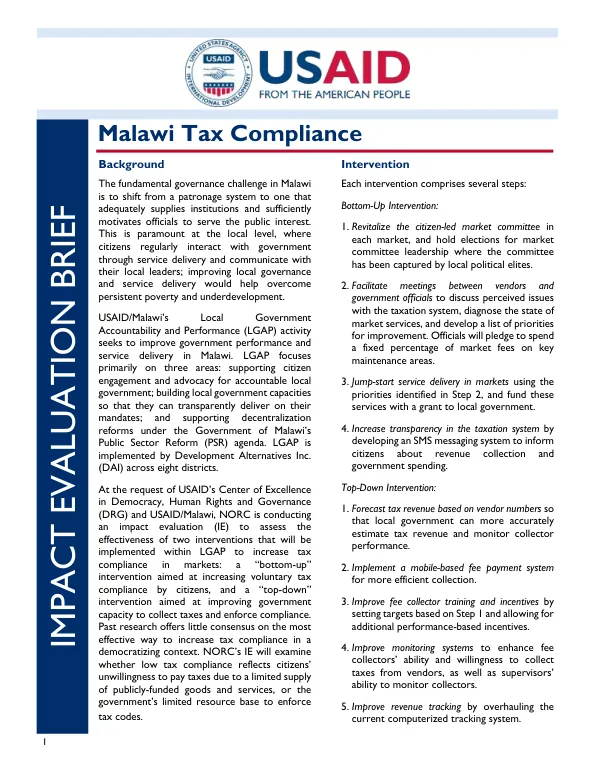
The Local Government Accountability and Performance (LGAP) activity implemented by Development Alternatives Inc.
2021 · 2 pages
Sign in to readA free account is required to download.
Abstract
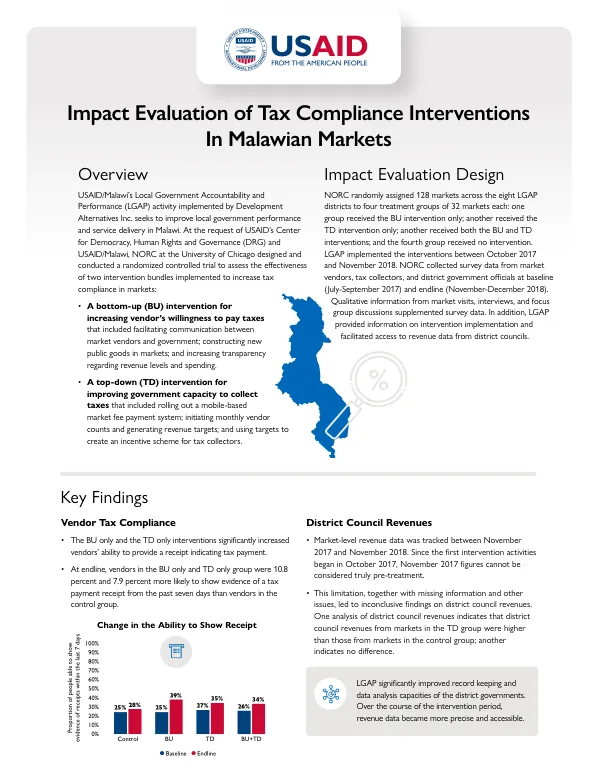
in Malawi aimed to improve local government performance and service delivery. As part of this initiative, USAID's Center for Democracy, Human Rights and Governance (DRG) and USAID/Malawi requested a randomized controlled trial to assess the effectiveness of two intervention bundles implemented to increase tax compliance in markets. The two intervention bundles were a bottom-up (BU) intervention and a top-down (TD) intervention. The BU intervention included facilitating communication between market vendors and government, constructing new public goods in markets, and increasing transparency regarding revenue levels and spending. The TD intervention included rolling out a mobile-based market fee payment system, initiating monthly vendor counts and generating revenue targets, and using targets to create an incentive scheme for tax collectors. The randomized controlled trial involved 128 markets across eight LGAP districts, which were randomly assigned to four treatment groups of 32 markets each. The treatment groups received either the BU intervention only, the TD intervention only, both interventions, or no intervention. The interventions were implemented between October 2017 and November 2018, and survey data were collected from market vendors, tax collectors, and district government officials at baseline (July-September 2017) and endline (November-December 2018). The key findings of the impact evaluation indicate that the BU only and TD only interventions significantly increased vendors' ability to provide a receipt indicating tax payment. At endline, vendors in the BU only and TD only groups were 10.8 percent and 7.9 percent more likely to show evidence of a tax payment receipt from the past seven days than vendors in the control group. The BU intervention consistently affected intermediate outcomes such as citizen trust, tax morale, and satisfaction with government services. In contrast, the TD intervention's effects on intermediate outcomes such as vendor compliance, tax collector effort, and corruption were more limited. Market-level revenue data was tracked between November 2017 and November 2018, but the findings were inconclusive due to missing information and other issues. However, one analysis indicated that district council revenues from markets in the TD group were higher than those from markets in the control group. LGAP significantly improved record keeping and data analysis capacities of the district governments, making revenue data more precise and accessible over the course of the intervention period. The impact evaluation suggests that future programming could benefit from additional research to identify differential effects of the interventions in different markets and assess the effectiveness of individual interventions. It is also recommended that future interventions of this kind build capacities for tracking outcomes prior to implementing the interventions, so that outcomes can be tracked more effectively.