USAID DEC
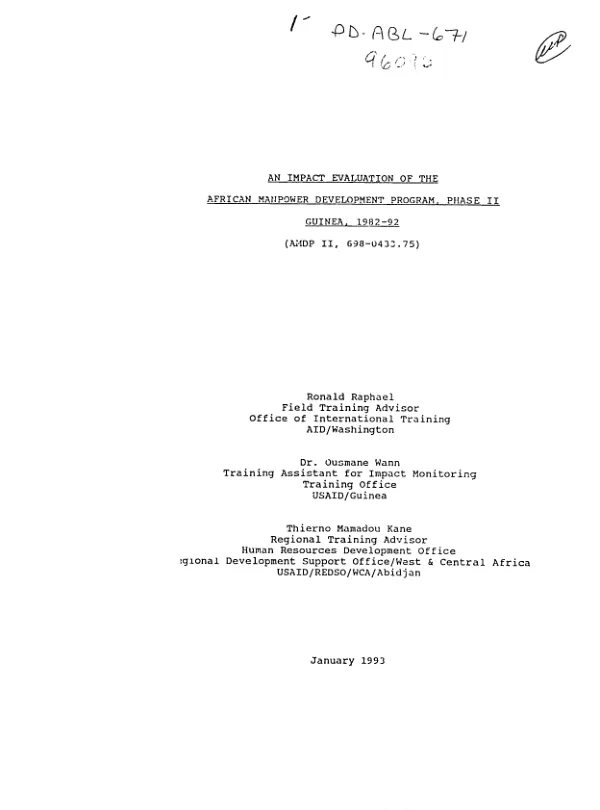
Impact evaluation of the African manpower development program, phase II : Guinea, 1982-92
Sign inUSAID. BUR. FOR AFRICA. OFC. OF REGIONAL AFFAIRS
Impact evaluation of the African manpower development program, phase II : Guinea, 1982-92
Evaluates the impact on Guinea of the African Manpower Development Program (AMDP II).
Raphael, Ronald; Wann, Ousmane +1 more · 1993
Sign in to readA free account is required to download.
Abstract
The evaluation covers the period 1982-92 and is based on interviews with 30 returned participants and 6 supervisors. The African Graduate Fellowship Program (AFGRAD), although a component of AMDP in the Project Paper, is not discussed evaluation; AFGRAD is generally considered a separate program because it is regionally funded, omitted from Country Training Plans, and implemented by the African-American Institute. Under AMDP II a total of 534 participants, most of them from public sector agencies in dire need of strengthening, were trained, either overseas or in country. The evaluators had a difficult time locating participants, who may be working in other than their targeted institutions or fields. However, both those interviewed and their supervisors were very pleased with the quality and appropriateness of the training, and its positive impacts on their job performance. Participants strongly asserted that the training has made them more effective in their jobs; supervisors generally concurred. The skills acquired by AMDP II participants are very relevant to USAID/Guinea"s current strategic goals. The impact of the training can only increase as the public sector institutional framework (which has been undergoing a good deal of reorganization) stabilizes and when USAID/G"s follow-on efforts, such as the Human Resources Development Assistance (HRDA) Project, bear fruit. The exclusion of AFGRAD from the evaluation makes the project"s impact on training institutions, a major objective, difficult to measure. AFGRAD was the more attractive program for graduate-level participants. The number of non-AFGRAD training participants from primary training institutions, including the Universities of Conakry and Kankan, Centre National de Perfectionnement en Gestion (CNPG), Centre de Perfectionnement en Administration (CPA), the Institute of Forestry at Faranah, and the Institute of Agricultural Research at Foulayah, was severely limited. This may be because in the 1980s many individuals went to the Soviet bloc to take advantage of the opportunities for Ph.D. level training there, and because small institutes such as CNPG and CPA had small staffs and could not afford to send many people for training at a time. The following lessons were learned. (1) Due to the absence of a formal selection process and the ministries" practice of selecting participants, the program lacked the transparency that is now the norm for selection. (2) Few participants or supervisors set concrete training goals, making it difficult to determine training impact; USAID should continue to require participants to articulate training expectations in cooperation with their employers, making it a prerequisite for selection. (3) Women made up 18% of the total number of participants. Constraints to women"s participation have been given considerable attention in the design of the HRDA Project. In-country short-term programs hold the best hope of maximizing recruitment of women. (4) Participants and their supervisors often do not know under which project they were funded, limiting their understanding of the overall context of their training; USAID should provide summaries of project papers to participants and supervisors.