USAID DEC
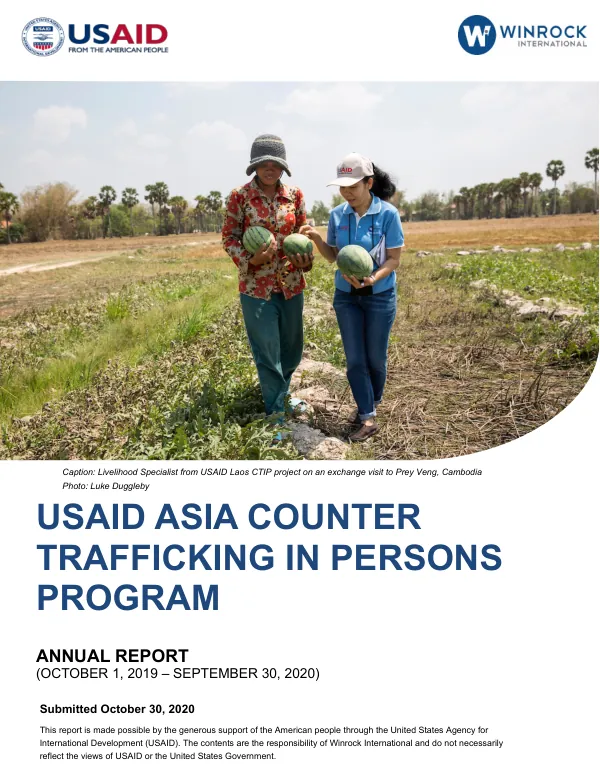
USAID Asia Counter Trafficking in Persons Program Annual Report (October 1, 2019 – September 30, 2020)
Sign inUSAID
USAID Asia Counter Trafficking in Persons Program Annual Report (October 1, 2019 – September 30, 2020)
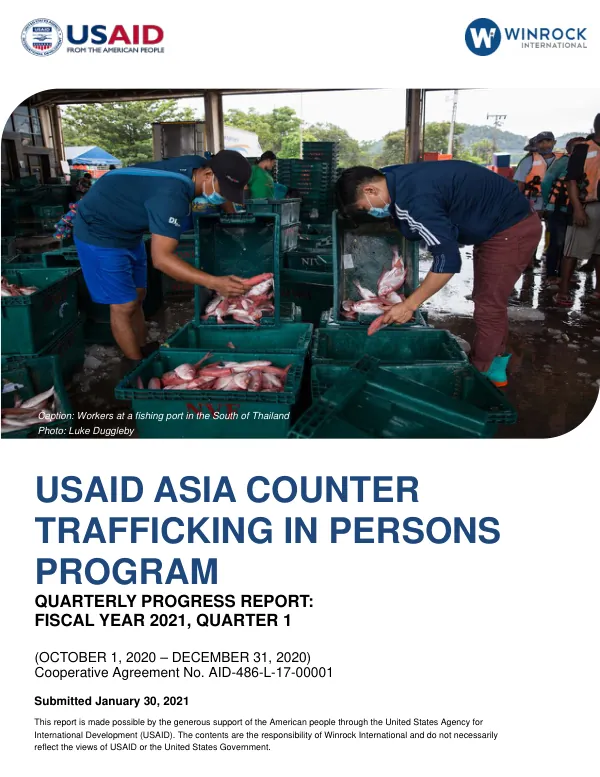
The USAID Asia Counter Trafficking in Persons (CTIP) program is a five-year initiative that focuses on transnational and regional challenges to combat Trafficking in Persons (TIP).
2020 · 65 pages
Sign in to readA free account is required to download.
Abstract
The program aims to strengthen learning around TIP, improve coordination and cooperation between source, transit, and destination countries, and reduce incentives for trafficking in persons through private sector engagement. The program has made significant progress in achieving its objectives, despite the challenges posed by the COVID-19 pandemic. The team and project partners have rapidly upskilled on new virtual tools, allowing workshops and capacity building sessions to continue at pace. Exciting achievements this year include the completion of participatory research on reintegration in Cambodia and Bangladesh, the publication of a gap analysis of TIP identification tools and a review of policy frameworks for identification and referrals in four countries, and the development of a Monitoring, Evaluation and Learning (MEL) in CTIP toolkit and a Gender Equality and Social Inclusion (GESI) in CTIP toolkit. The program has also supported associate and bilateral projects, organizing nine capacity building sessions, three technical exchanges, one learning visit from Laos CTIP to Cambodia, and monthly coordination meetings. The project has provided ongoing support on MEL and Private Sector Engagement (PSE), strengthening the quality of their work and capacity of staff. The program has developed analysis and recommendations for countries in the region, such as the analysis from the TIP report and the gap analysis on identification tools. However, the challenge remains in achieving stronger results in influencing regional policies. The project has targeted Memorandum of Understandings (MoU) to increase protection for fishermen and improve the migration and recruitment policies from Bangladesh to Malaysia. The program has also achieved significant milestones in terms of numbers, including: * 23 learning products developed and disseminated by USAID Asia CTIP * 2,244 stakeholders reached through dissemination of USAID Asia CTIP learning products * 221 new CSOs utilizing regional platforms/networks for information sharing * 9 actions by private sector to reduce risks in TIP * 3 private sector partnership brokered through USAID Asia CTIP's Technical Assistance * 3 Rapid Assessments conducted in Cambodia, Bangladesh, and Nepal among returned labor migrants in the COVID-19 context * 13 new organizations in the Asia region using the Victim Case Management System (VCMS) * 586 attendees joined the 8 webinars held with Freedom Collaborative during the year – including 4 COVID-19 Rapid Response webinars * 24 local researchers trained within 3 research and joint research projects * MEL in CTIP toolkit and GESI in CTIP toolkit developed and published * Participatory reintegration research conducted in Cambodia and Bangladesh * 1 Social Network Analysis conducted * 9 capacity building sessions, 1 exposure visit, and 3 technical exchanges conducted The program has continued to adapt its work to the new situation and achieved most of its targets with few delays on planned activities.
Related documents