USAID
Impact of Health Communication on Continuum of Care
Community engagement and support have been found to have a positive impact on various aspects of antiretroviral therapy (ART) programs, including access, coverage, adherence, virological and immunological outcomes, patient retention, and survival.
2015 · 5 pages
Sign in to readA free account is required to download.
Abstract
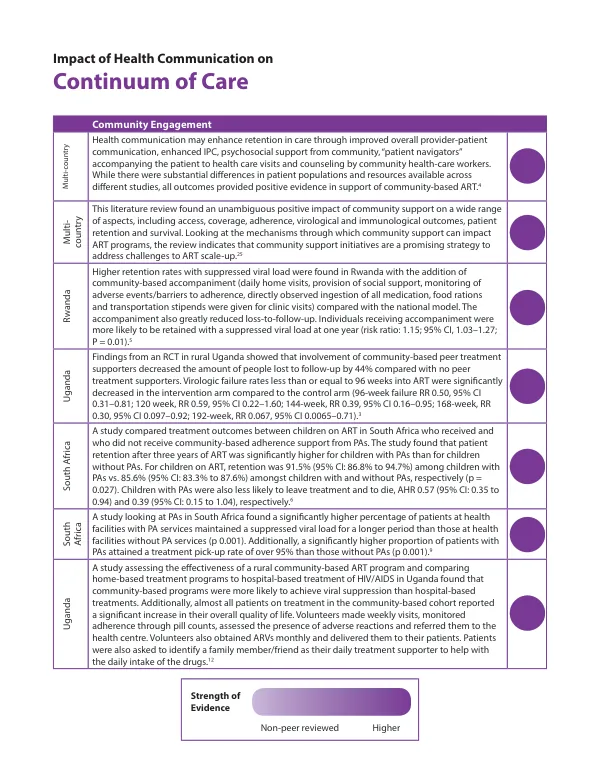
A multi-country literature review indicates that community support initiatives are a promising strategy to address challenges to ART scale-up. In Rwanda, the addition of community-based accompaniment, which included daily home visits, provision of social support, monitoring of adverse events, and directly observed ingestion of medication, resulted in higher retention rates with suppressed viral load compared to the national model. The accompaniment also reduced loss-to-follow-up rates. Individuals receiving accompaniment were more likely to be retained with a suppressed viral load at one year. In Uganda, a randomized controlled trial (RCT) found that involvement of community-based peer treatment supporters decreased the amount of people lost to follow-up by 44% compared to no peer treatment supporters. Virologic failure rates were also significantly decreased in the intervention arm compared to the control arm. A study in Uganda also found that community-based ART programs were more likely to achieve viral suppression than hospital-based treatments. In South Africa, a study compared treatment outcomes between children on ART who received and did not receive community-based adherence support from peer advocates (PAs). The study found that patient retention after three years of ART was significantly higher for children with PAs than for children without PAs. Children with PAs were also less likely to leave treatment and to die. Community-based ART programs have also been found to improve quality of life, dignity, and sense of belonging among people living with HIV/AIDS (PLHIV). In Kenya, community members were trained as community health workers (CHWs) to provide home-based care to HIV/AIDS clients in rural areas. An assessment of this intervention found an improved quality of life, dignity, and sense of belonging among PLHIV, as well as reduced stigma and an increase in testing. In Uganda, evaluation of the community-based ART (CBART) programs using community volunteers found a significant increase in physical and mental health among HIV-positive clients. A community-based ART program in Rwanda achieved 92.3% retention in care after 24 months by enrolling patients in education and support groups that met the same day as clinic appointments and included daily visits by trained CHWs. Interpersonal communication has also been found to play a crucial role in improving linkage to care and adherence to ART. In Kenya, treatment enrollment rates were significantly higher among participants in a community-based HIV testing campaign who received a visit from a person living with HIV. A group-based treatment intervention in India that included a regular visit with a provider and three one-hour sessions each month addressing HIV, ARVs, adherence, and coping led to improved adherence. Overall, the evidence suggests that community engagement and support, as well as interpersonal communication, are critical components of effective ART programs. These interventions have been found to improve access, coverage, adherence, and outcomes, and to reduce loss-to-follow-up rates and mortality.