CHEMONICS
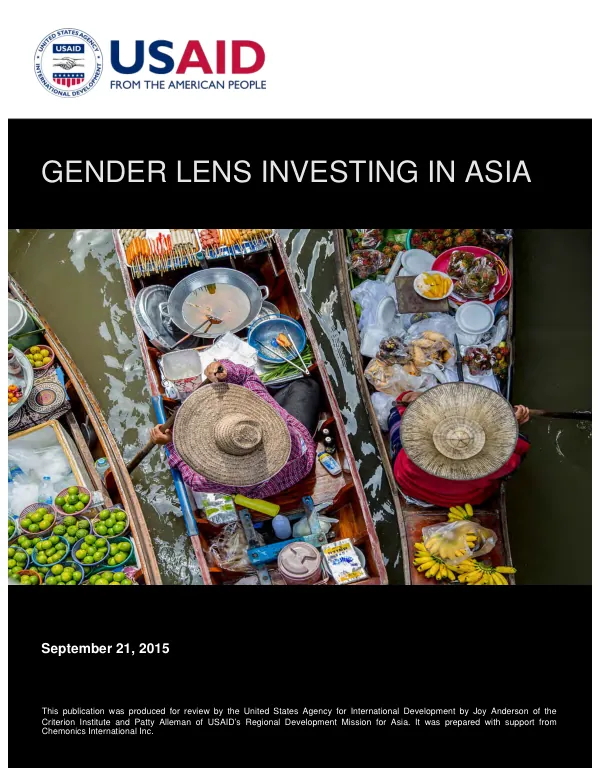
Gender Lens Investing in Asia
Gender Lens Investing in Asia is a concept that involves the intentional integration of a gender analysis into financial analysis to make better investment decisions.
2015 · 30 pages
Sign in to readA free account is required to download.
Abstract
This approach is based on a systematic analytical process that identifies, understands, and understands the gender differences and the relevance of gender roles and power dynamics in a specific context. In the context of defining an investment strategy, the gender analysis can include making available money to enterprises led by women, focusing on equity and employment opportunities for women, or investing in products and services that benefit women and girls. The definition of gender lens investing has evolved over time, with individuals in finance assigning financial value based on an analysis of the company, the company's economic environment, and the larger economic environment. However, awareness of the language and concepts around gender analysis is limited, with many individuals assuming that gender analysis refers to investing in women-led businesses, usually small or micro-enterprises. This limited concept of gender analysis leads to a narrow understanding of the broader impact and applications of a gender analysis in investments. A second definition of gender lens investing has emerged, which involves the intentional use of finance as a tool to achieve gender-equitable social change, considering the benefits to women and girls. This definition resonates with individuals and organizations with a gender focus, such as the International Center for Research on Women (ICRW) and Bachpan Bachao Andolan. These organizations design programs based on a thorough analysis of the gender dynamics in institutions and sectors, and they see the potential for finance to complement policy, media, and community strategies for inclusive social change. A gender analysis framework is a continuum that ranges from counting women to valuing gender. For individuals focused on social development, including those in the community of international development, applying a gender analysis to defining priority programming is standard practice. This involves considering the intersection of climate change and gender, programming that highlights the importance of women-led businesses in the energy sector, and a fuller gender analysis that highlights the importance of addressing systemic inequities. The assessment of gender lens investing in Asia was conducted by USAID's Regional Development Mission for Asia (RDMA) and the Criterion Institute, with support from Chemonics International Inc. The assessment aimed to highlight leadership and activities in Asia and make recommendations to accelerate the field of gender lens investing. The assessment had a three-pronged approach: identifying opportunities that were moving forward or had the potential to move forward with assistance, identifying and engaging leaders in the field of gender lens investing in Asia, and convening gender lens investing leaders in Asia. The assessment involved a series of visits to Washington, D.C., New York, Vietnam, Bangladesh, Singapore, Hong Kong, Indonesia, the Philippines, and Thailand, where the team held discussions with 166 individuals. The team also engaged more than 200 leaders in Asia through formal interviews and informal conversations, and convened 46 leaders in Asia in Bangkok, Thailand, to discuss their roles and develop ways to move the field forward. The assessment highlighted the importance of accelerating the field of gender lens investing in Asia, with a focus on promoting inclusive economic growth and strengthening women's economic empowerment. The assessment also emphasized the need for a more nuanced understanding of the concept of gender lens investing, one that goes beyond investing in women-led businesses and considers the broader impact and applications of a gender analysis in investments. The assessment identified several key findings, including the need for a more nuanced understanding of the concept of gender lens investing, the importance of promoting inclusive economic growth and strengthening women's economic empowerment, and the need for a more comprehensive approach to gender analysis that considers the intersection of climate change and gender. The assessment also made several recommendations, including the need for USAID and other donors to provide more support for the field of gender lens investing, the need for financial institutions to develop more gender-sensitive investment products, and the need for governments to develop more policies and regulations that support gender lens investing. Overall, the assessment of gender lens investing in Asia highlights the importance of promoting inclusive economic growth and strengthening women's economic empowerment, and the need for a more nuanced understanding of the concept of gender lens investing. The assessment provides a comprehensive overview of the field of gender lens investing in Asia, and makes several recommendations for accelerating the field.