DEVTECH SYSTEMS INC.
Impact of rural roads : final report
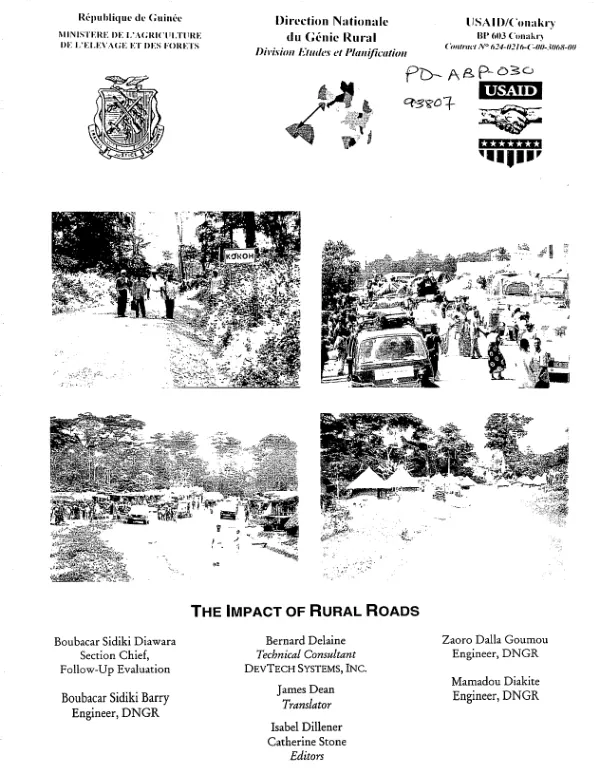
This report describes the village-level impacts of road rehabilitation undertaken in Guinea by the National Rural Infrastructure Project (PNIR).
Diawara, Boubacar|Delaine, Bernard · 1996
Sign in to readA free account is required to download.
Abstract
Impact on agricultural markets has been considerable; now that villages are linked to the world year round, marketing traffic has increased six-fold and volume of products sold has increased five-fold. Agricultural productivity has also improved; land under cultivation has increased by 61% and volume of commodities sold has increased by 113%. Villagers have also enjoyed increased access to health care and education: percentages of villages with health posts has increased from 29% to 77%, with deep bore holes with drinkable water from 34% to 86%, and with schools from 46% to 95%. Reduced time and transportation costs have led to a sixfold increase in weekly commerce. There has also been an increase in the number of small- and medium-scale enterprises. These have been provided with training to improve their negotiation skills for competitively bidding on contracts with the Guinean National Directorate for Rural Engineering (DNGR) to rebuild rural roads. More training is needed, however, since only a few businesses are truly performing. The project has improved the institutional capacities of the DNGR itself, which has completed dozens of surveys to solicit bids on major road lots, and signed contracts with large companies and for the performance of communal work. Out of a projected total of 5,600 km of roads to be rebuilt, over 3,900 km are now finished. Environmental impact of road rehabilitation has been minimal. Reforestation activities have diminished any detrimental effect on forests where it has occurred, and the risk of erosion has been diminished through improvement of drainage systems. The only environmental liability has been the blowing of dust into houses by speeding vehicles during the dry season. Annexes contain data on village surveys for the years 1994-96, and illustrations of roads before and after rehabilitation.