USAID
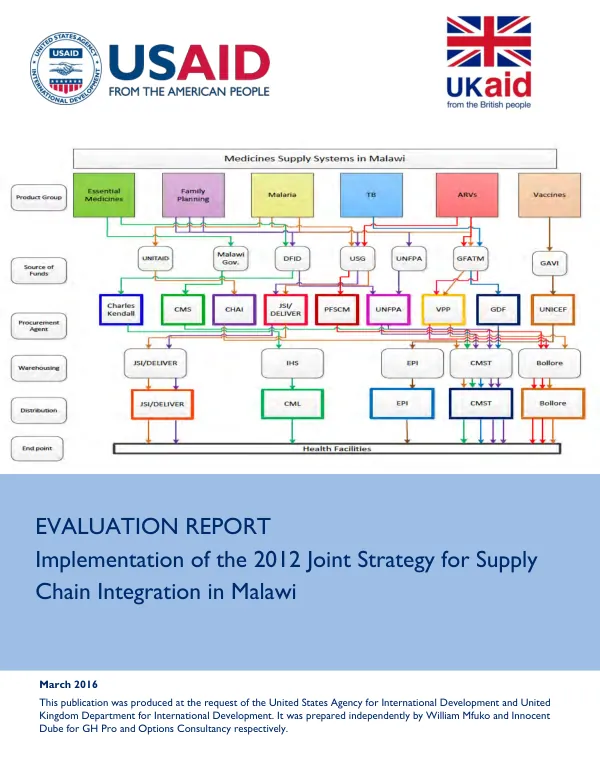
Implementation of the 2012 Joint Strategy for Supply Chain Integration in Malawi
The 2012 Joint Strategy for Supply Chain Integration in Malawi aimed to strengthen the country's health system by improving the efficiency and effectiveness of the medicines supply chain.
2016 · 88 pages
Sign in to readA free account is required to download.
Abstract
The strategy involved the implementation of 36 benchmarks, which were designed to address key challenges in the supply chain, including stock management, distribution, and last-mile delivery. The evaluation report, conducted in March 2016, assessed the implementation of the 2012 Joint Strategy and its impact on the supply chain. The report found that the implementation of the benchmarks was generally satisfactory, with an overall implementation rate of 73% across all phases. However, there were significant variations in the implementation of individual benchmarks, with some showing high levels of achievement while others were poorly implemented. The report identified several key challenges in the implementation of the benchmarks, including inadequate training and capacity building for staff, insufficient resources and equipment, and poor communication and coordination between stakeholders. Despite these challenges, the report noted that the implementation of the benchmarks had led to significant improvements in the supply chain, including increased medicines availability, improved stock management, and enhanced last-mile delivery compliance. The evaluation framework used in the report consisted of a literature review, in-country key informant interviews, and field visits. The data capture and sources included surveys, interviews, and observations, which were analyzed using descriptive statistics and thematic analysis. The report noted that the evaluation framework was designed to assess the implementation of the benchmarks and their impact on the supply chain, and to identify areas for improvement. The report concluded that the implementation of the 2012 Joint Strategy had made significant progress in strengthening the health system in Malawi, but that there were still challenges to be addressed. The report recommended that the government and stakeholders continue to support the implementation of the benchmarks, and that efforts be made to address the challenges identified in the report. The report also recommended that the government and stakeholders consider implementing additional measures to improve the supply chain, including the development of a national medicines policy and the establishment of a medicines supply chain management system. The report noted that the implementation of the benchmarks had led to significant improvements in the supply chain, including increased medicines availability, improved stock management, and enhanced last-mile delivery compliance. The report also noted that the implementation of the benchmarks had improved the overall performance of the supply chain, with an increase in the number of medicines delivered to health facilities and a reduction in stockouts. The report identified several key areas for improvement, including the need for additional training and capacity building for staff, the need for improved communication and coordination between stakeholders, and the need for increased resources and equipment. The report also noted that the government and stakeholders should consider implementing additional measures to improve the supply chain, including the development of a national medicines policy and the establishment of a medicines supply chain management system.
![Measurement Approaches for Effective Coverage Estimation [MR31]](https://covers.devme.ai/gen/138167.webp)