USAID DEC
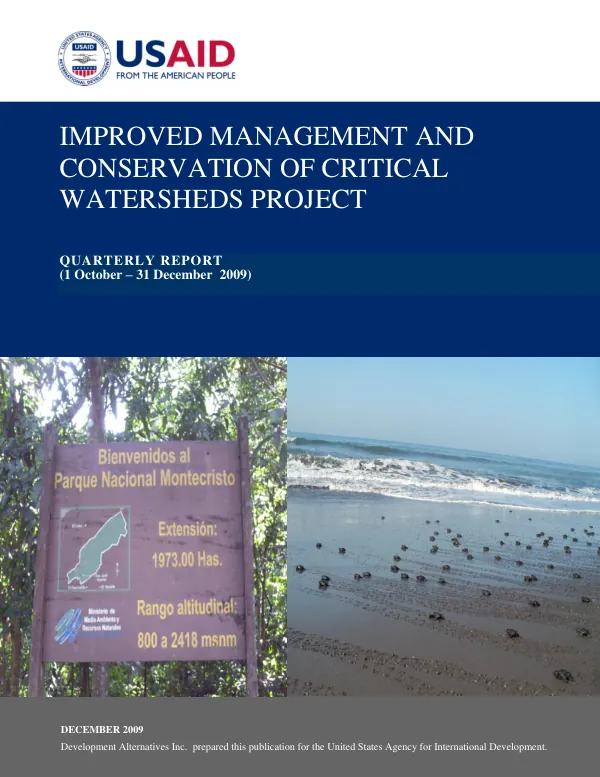
Improved Management and Conservation of Critical Watersheds Project Quarterly Report (1 October – 31 December 2009)
Sign inDAI
Improved Management and Conservation of Critical Watersheds Project Quarterly Report (1 October – 31 December 2009)
Improved Management and Conservation of Critical Watersheds Project began in 2007 with funding from the United States Agency for International Development (USAID).
2009 · 155 pages
Sign in to readA free account is required to download.
Abstract
The project aimed to improve management and conservation of critical watersheds in El Salvador. The project's strategic objective was to enhance the capacity of local communities to manage and conserve critical watersheds, thereby reducing the risk of landslides and improving water quality. The project focused on two key areas: improved management of Montecristo National Park and species-based conservation of lower watersheds. In Montecristo National Park, the project implemented environmental education, communication, and training programs to raise awareness among local communities about the importance of conservation. Economic alternatives and mitigation measures were also introduced to reduce the impact of human activities on the park's ecosystem. Financial sustainability was ensured through the development of a financial plan and the establishment of a trust fund. In the lower watersheds, the project implemented species-based conservation programs to protect endangered species such as sea turtles. Environmental education, communication, and training programs were conducted to raise awareness among local communities about the importance of conservation. Economic alternatives and mitigation measures were introduced to reduce the impact of human activities on the ecosystem. Financial sustainability was ensured through the development of a financial plan and the establishment of a trust fund. The project achieved several success stories, including the establishment of sea turtle egg bans and hatcheries, the conservation of the La Comunidad de San Blas y las Tortugas Marinas, and the protection of the Muro of Cárcava No. 1. The project also implemented a number of deliverables and indicators, including the improved management of Montecristo National Park and the species-based conservation of lower watersheds. The project's administration was overseen by a project director and a team of staff, including new staff members who were hired during the quarter. The project also conducted a number of subcontractor visits, SOWs, and trip reports, and established local payment for services contracts. The project's references included a number of reports and documents, including the new staff terms of reference, STTA SOWs, and subcontractor TORs. The project's financial sustainability was ensured through the development of a financial plan and the establishment of a trust fund. The project also implemented a number of economic alternatives and mitigation measures to reduce the impact of human activities on the ecosystem. The project's success was measured through a number of indicators, including the improved management of Montecristo National Park and the species-based conservation of lower watersheds. The project's geographic focus was on El Salvador, with a specific emphasis on the Montecristo National Park and the lower watersheds. The project's timeframes were from 2007 to 2010, with quarterly reports submitted to USAID. The project's recommendations included the continued support for the project's activities and the establishment of a long-term conservation plan for the Montecristo National Park and the lower watersheds.
Related documents