USAID DEC
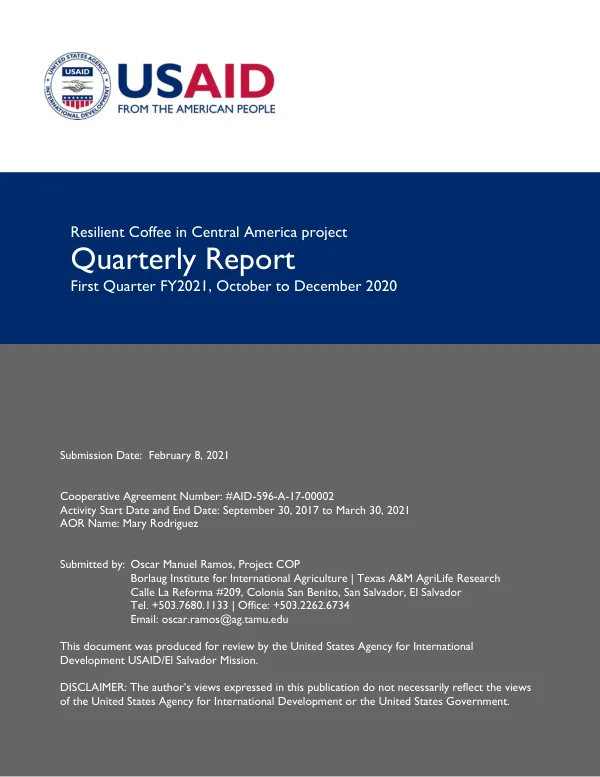
Resilient Coffee in Central America project Quarterly Report First Quarter FY2021, October to December 2020
Sign inCARE
Resilient Coffee in Central America project Quarterly Report First Quarter FY2021, October to December 2020
The Resilient Coffee in Central America project is a cooperative agreement between the United States Agency for International Development (USAID) and the Norman Borlaug Institute for International Agriculture at Texas A&M AgriLife Research.
2021 · 22 pages
Sign in to readA free account is required to download.
Abstract
The project aims to improve the resilience of coffee production in Central America, particularly in El Salvador, Honduras, and Guatemala. During the first quarter of FY2021, the project team invested significant efforts in monitoring and evaluating the development and growth of coffee plants in demonstration plots established in FY2018 and FY2019. The project partners in the demonstration plots played a crucial role in following up and recording daily activities, both in the agronomic phase and documenting employment input. The project team also consolidated important alliances with various organizations, including YARA Fertilizers, Nestlé, S.A., Optimun Coffee, and Naranjos Coffee, to improve the coffee value chain in all countries. The project participated in the National Sustainable Coffee conference of Honduras, where an overall summary of the Resilient Coffee project and the behavior of coffee hybrids compared to traditional varieties was presented. The project team designed posters for specific recommendations on coffee rust control, project information, and COVID-19 prevention measures in coffee production units. The posters were distributed to partners and producers in the seven coffee-growing regions of Guatemala and regions in El Salvador. Additionally, the project gave training classes on coffee grafting, mainly to young people involved in different stages of coffee production, and on the methods of preparation of coffee and barista skills and techniques. A total of 4,256 producers and local technical experts participated in the varied activities carried out by the project, including training, field visits to demo plots, and forums. The project also distributed important information to project partners and the general public on how to take preventive actions for the approach of the Hurricanes Eta and Iota. The cupping analyses results were published, providing results for samples of the varieties and hybrids planted on demonstration plots of partners in El Salvador and Honduras. The cupping was carried out by an ASCAFE panel of selected cuppers, following the Specialty Coffee Association (SCA) protocols. The results showed that the Central American H-1 hybrid scored 85.25 points, classifying it as specialty coffee. The project's implementation status is as follows: * Pillar 1: Establishing Resilient Coffee Options and Business Opportunities - Results from the cupping analyses were published, and the Central American H-1 hybrid scored 85.25 points. * Pillar 2: Demonstrating Climate-Smart Coffee Cultivation - The project team monitored and evaluated the development and growth of coffee plants in demonstration plots established in FY2018 and FY2019. * Pillar 3: Dissemination of Resilient Production and Better Environmental Practices - The project team designed posters for specific recommendations on coffee rust control, project information, and COVID-19 prevention measures in coffee production units. * Pillar 4: Access to Finance, New Business Opportunities, and Employment - The project gave training classes on coffee grafting and on the methods of preparation of coffee and barista skills and techniques. * Pillar 5: Strengthening Research Capacities - The project team participated in the National Sustainable Coffee conference of Honduras and presented an overall summary of the Resilient Coffee project and the behavior of coffee hybrids compared to traditional varieties. The project's geographic coverage includes El Salvador, Honduras, and Guatemala, and the reporting period is October to December 2020.
Related documents