USAID DEC
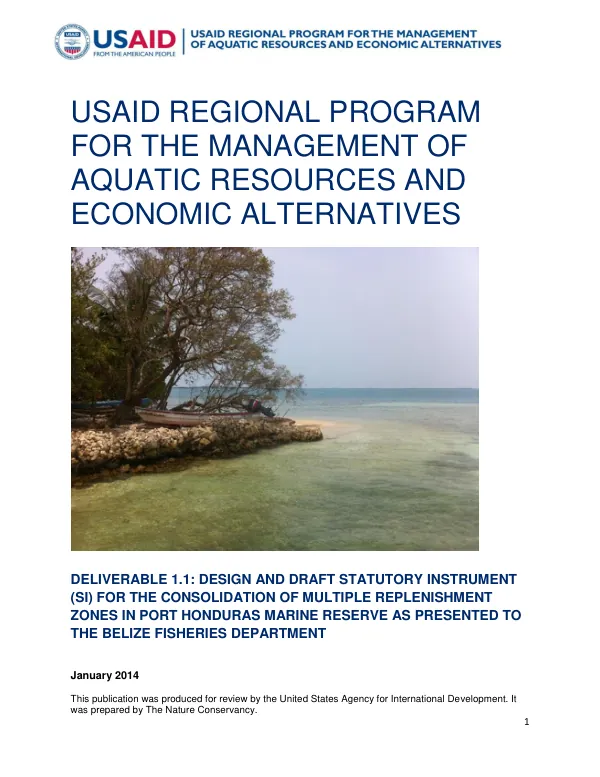
Improved Management of Port Honduras Marine Reserve through the Consolidation of Multiple Replenishment Zones
Sign inINTERNATIONAL INSTITUTE FOR ENVIRONMENT AND DEVELOPMENT
Improved Management of Port Honduras Marine Reserve through the Consolidation of Multiple Replenishment Zones
The Port Honduras Marine Reserve, PHMR, is a Marine Protected Area located in the Toledo District of southern Belize.
2014 · 22 pages
Sign in to readA free account is required to download.
Abstract
The reserve covers an area of 40,339 hectares and incorporates four distinct ecosystems: coastal and tidal wetlands, marine lagoonal habitats, mangrove islands, and the Snake Cayes fringing reef system. PHMR contributes significantly to the Mesoamerican Reef System by providing nursery habitat for reef species, including the critically endangered goliath grouper. The reserve also contains some of the least impacted reefs in the Mesoamerican Reef, with the reef fringing East Snake Caye boasting 22% coral cover and only 6% macro-algal cover. The reserve is co-managed by the Fisheries Department and the Toledo Institute for Development and Environment, TIDE, with TIDE responsible for day-to-day management. Management methods include replenishment zones, Managed Access, and gear restrictions. There are currently five replenishment zones in PHMR, each extending half a mile radius from one caye, covering a total area of 1,300 hectares or 3.2% of the reserve's area. Four of the zones are open to tourism, while one is completely off-limits except for research and emergency rescue. Managed Access was implemented in July 2011, limiting commercial fishing rights to traditional users and reducing the number of commercial fishers using PHMR from around 300 to 129. Managed Access licensees report improved catches, and initial data suggest positive impacts on stocks. Gear restrictions are also in place, prohibiting certain types of fishing gear such as fish traps, gill nets, and long lines. The reserve is home to a diverse range of species, including the critically endangered goliath grouper, and provides livelihoods for 129 managed access licensees and food security to over 100 subsistence fishers and their families. The local population, totaling around 7,000, relies heavily on local seafood, with 59% consuming it at least twice a week. The reserve's reefs underwent extensive bleaching in 1998 but have since recovered, with mean live coral cover increasing steadily from 7% in 2003 to 15% in 2008 and remaining stable since. The proposed Statutory Instrument for the consolidation of multiple replenishment zones in PHMR aims to improve management of the reserve. The consolidation process involved community consultation and participation, with informal and formal meetings held with the majority of the fishing population to discuss the proposed changes to the RZ and assess their support for the consolidation and expansion of RZ. The end result is a proposed Statutory Instrument for consideration and approval by the Belize Fisheries Department. The consolidation of multiple replenishment zones in PHMR is expected to improve management of the reserve by reducing the complexity of the current zoning system and increasing the effectiveness of conservation efforts. The proposed Statutory Instrument outlines the criteria used for the consolidation of three of PHMR's existing RZ, including the consideration of ecological, social, and economic factors. The consolidation process is expected to result in improved management of the reserve, increased conservation of marine resources, and enhanced benefits for local communities. The proposed Statutory Instrument also outlines the proposed RZ consolidation, which involves the consolidation of five existing RZ into three new zones. The new zones will be designed to reduce the complexity of the current zoning system and increase the effectiveness of conservation efforts. The consolidation process is expected to result in improved management of the reserve, increased conservation of marine resources, and enhanced benefits for local communities. The proposed Statutory Instrument has undergone a rigorous consultation process, involving community meetings and feedback from local stakeholders. The consultation process has resulted in a proposed Statutory Instrument that reflects the needs and concerns of local communities and stakeholders. The proposed Statutory Instrument is expected to improve management of the reserve, increase conservation of marine resources, and enhance benefits for local communities. The consolidation of multiple replenishment zones in PHMR is a critical step towards improving management of the reserve and increasing conservation of marine resources. The proposed Statutory Instrument outlines the criteria used for the consolidation of three of PHMR's existing RZ, including the consideration of ecological, social, and economic factors. The consolidation process is expected to result in improved management of the reserve, increased conservation of marine resources, and enhanced benefits for local communities.
Related documents