USAID DEC
Improved Water Resources Management for Agricultural Systems _GFSS Activity Design Guidance
Sign inUSAID
Improved Water Resources Management for Agricultural Systems _GFSS Activity Design Guidance
Sustainable, agriculture-led economic growth is critical to development and to reducing poverty, hunger, and malnutrition globally.
2023 · 11 pages
Sign in to readA free account is required to download.
Abstract
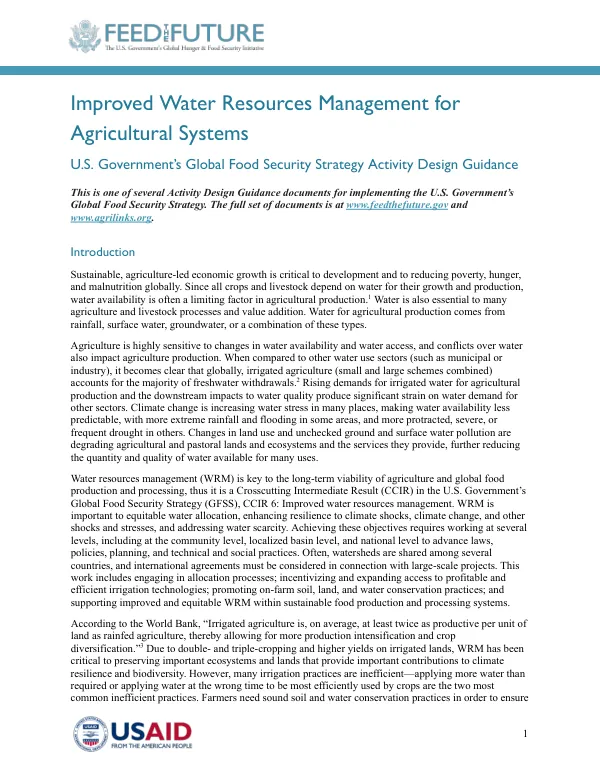
Water availability is often a limiting factor in agricultural production, as all crops and livestock depend on water for their growth and production. Water for agricultural production comes from rainfall, surface water, groundwater, or a combination of these types. Agriculture is highly sensitive to changes in water availability and water access, and conflicts over water also impact agriculture production. Globally, irrigated agriculture accounts for the majority of freshwater withdrawals, with rising demands for irrigated water for agricultural production and the downstream impacts to water quality producing significant strain on water demand for other sectors. Climate change is increasing water stress in many places, making water availability less predictable, with more extreme rainfall and flooding in some areas, and more protracted, severe, or frequent drought in others. Changes in land use and unchecked ground and surface water pollution are degrading agricultural and pastoral lands and ecosystems and the services they provide, further reducing the quantity and quality of water available for many uses. Water resources management (WRM) is key to the long-term viability of agriculture and global food production and processing. WRM is a Crosscutting Intermediate Result (CCIR) in the U.S. Government's Global Food Security Strategy (GFSS), CCIR 6: Improved water resources management. Achieving WRM objectives requires working at several levels, including at the community level, localized basin level, and national level to advance laws, policies, planning, and technical and social practices. Locally led and inclusive development is vital for improving WRM for agricultural systems, capturing the knowledge and experience of all participating household members and often marginalized groups within communities. According to the World Bank, irrigated agriculture is, on average, at least twice as productive per unit of land as rainfed agriculture, thereby allowing for more production intensification and crop diversification. However, many irrigation practices are inefficient, applying more water than required or applying water at the wrong time to be most efficiently used by crops. Farmers need sound soil and water conservation practices in order to ensure sufficient soil moisture for crop growth and water availability at the right time during all cultivation stages. Successfully managing water quantity, quality, and timing, alongside other crop inputs, maximizes harvests and incomes at the farm level. Locally led and inclusive development is vital for improving WRM for agricultural systems. It is essential to capture the knowledge and experience of all participating household members and often marginalized groups within communities, not just the head of household or "community leaders." People from various backgrounds engage in agriculture, from laboring on an hourly basis to renting a small field or owning a large farm. Many entry points mean that people in agriculture can be old or young, male or female, and wealthy or extremely poor. Marginalized groups experience uneven access to inputs and credit, disproportionate representation in group discussions and decision-making, spatial disadvantages, and insecure land and water tenure. Inclusive institutions where stakeholders participate in decision-making about allocating water equitably and efficiently are important for strengthening inclusive development. Livestock, aquaculture, freshwater fisheries, and marine fisheries are important consumers and beneficiaries of water and WRM. The U.S. Government's Global Food Security Strategy Activity Design Guidance for Investing in Livestock and Animal Source Food Systems, the GFSS Activity Design Guidance for Sustainable Aquaculture Production Systems, and the GFSS Activity Design Guidance for Sustainable Fisheries Management provide additional guidance on WRM for these production systems. Key terms in WRM include applied water, blue water, catchment, river basin, or watershed, landscape-level approaches, consumed water, green water, multiple-use water services, resilience, water productivity ratio, water scarcity, and withdrawn water. Interventions to improve WRM for agriculture and food systems can include landscape-level approaches, water-saving technologies, and water management practices that promote efficient use of water.
Related documents