USAID
Improving Energy Sector Performance in the West Bank
The energy sector in the West Bank faces complex challenges, with local electricity generation being minimal and the market heavily reliant on electricity imports.
2019 · 1 pages
Sign in to readA free account is required to download.
Abstract
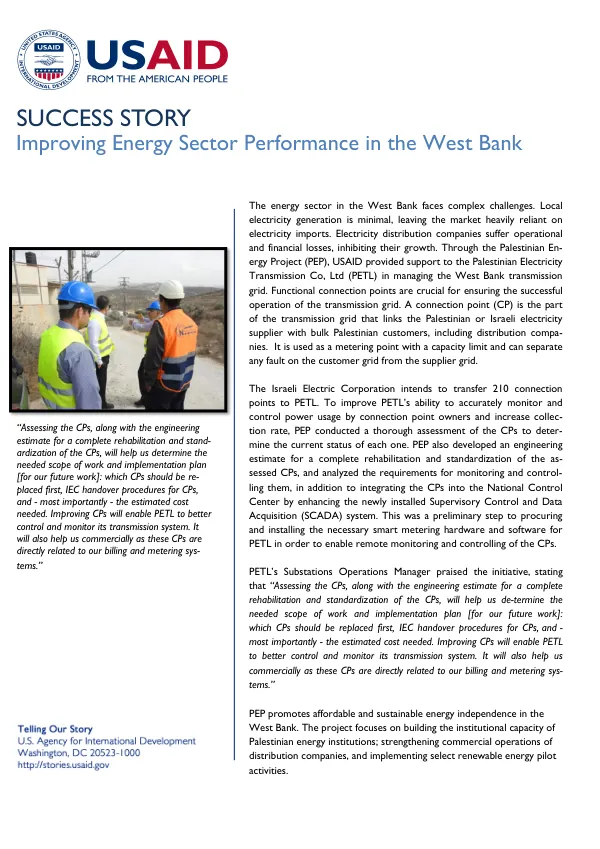
Electricity distribution companies suffer operational and financial losses, inhibiting their growth. The Palestinian Electricity Transmission Co, Ltd (PETL) manages the West Bank transmission grid, with functional connection points being crucial for ensuring the successful operation of the transmission grid. A connection point (CP) is the part of the transmission grid that links the Palestinian or Israeli electricity supplier with bulk Palestinian customers, including distribution companies. It is used as a metering point with a capacity limit and can separate any fault on the customer grid from the supplier grid. The Israeli Electric Corporation intends to transfer 210 connection points to PETL. To improve PETL's ability to accurately monitor and control power usage by connection point owners and increase collection rate, a thorough assessment of the CPs was conducted to determine the current status of each one. The assessment was followed by an engineering estimate for a complete rehabilitation and standardization of the assessed CPs. Requirements for monitoring and controlling them were analyzed, in addition to integrating the CPs into the National Control Center by enhancing the newly installed Supervisory Control and Data Acquisition (SCADA) system. This was a preliminary step to procuring and installing the necessary smart metering hardware and software for PETL to enable remote monitoring and controlling of the CPs. PETL's Substations Operations Manager praised the initiative, stating that assessing the CPs, along with the engineering estimate for a complete rehabilitation and standardization of the CPs, will help determine the needed scope of work and implementation plan. This includes which CPs should be replaced first, IEC handover procedures for CPs, and the estimated cost needed. Improving CPs will enable PETL to better control and monitor its transmission system, as well as help commercially, as these CPs are directly related to billing and metering systems. The Palestinian Energy Project (PEP) promotes affordable and sustainable energy independence in the West Bank. The project focuses on building the institutional capacity of Palestinian energy institutions, strengthening commercial operations of distribution companies, and implementing select renewable energy pilot activities. By improving the energy sector in the West Bank, PEP aims to increase energy access and reduce reliance on imported electricity.