USAID
Improving Public Safety Using Risk-Based Post-Marketing Surveillance
Improving Public Safety Using Risk-Based Post-Marketing Surveillance Substandard and falsified medicines pose a serious risk to public health in many low- and middle-income countries (LMICs).
2018 · 2 pages
Sign in to readA free account is required to download.
Abstract
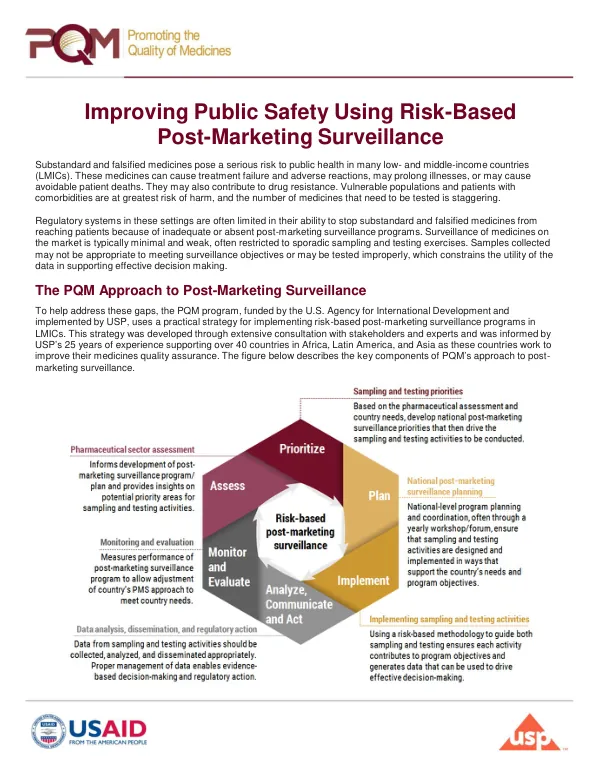
These medicines can cause treatment failure and adverse reactions, may prolong illnesses, or may cause avoidable patient deaths. They may also contribute to drug resistance. Vulnerable populations and patients with comorbidities are at greatest risk of harm, and the number of medicines that need to be tested is staggering. Regulatory systems in these settings are often limited in their ability to stop substandard and falsified medicines from reaching patients because of inadequate or absent post-marketing surveillance programs. Surveillance of medicines on the market is typically minimal and weak, often restricted to sporadic sampling and testing exercises. Samples collected may not be appropriate to meeting surveillance objectives or may be tested improperly, which constrains the utility of the data in supporting effective decision making. The PQM Approach to Post-Marketing Surveillance To address these gaps, the PQM program, funded by the U.S. Agency for International Development and implemented by USP, uses a practical strategy for implementing risk-based post-marketing surveillance programs in LMICs. This strategy was developed through extensive consultation with stakeholders and experts and was informed by USP's 25 years of experience supporting over 40 countries in Africa, Latin America, and Asia as these countries work to improve their medicines quality assurance. The PQM approach aims to help countries design and implement technically sound, effective, and sustainable national post-marketing surveillance programs appropriate for each unique country context. MedRS: The Medicines Risk-based Surveillance Tool To support countries in implementing post-marketing surveillance programs and activities, PQM has developed the Medicines Risk-based Surveillance (MedRS) tool to simplify the development of sampling methods and help national regulatory authorities to consistently implement risk-based approaches. The tool helps countries answer important questions they encounter when planning and implementing post-marketing surveillance, including which medicines, geographical locations, and outlets should be sampled, how many geographical locations and outlets should be sampled, and how many samples should be collected. The MedRS tool integrates and automates the science and practice of a risk-based post-marketing surveillance program into a single platform, generating stratified, randomized sampling as a best practice. PQM is funded by the U.S. Agency for International Development (USAID) and led by the U.S. Pharmacopeial Convention (USP). USP has worked with USAID for 25 years to support low- and middle-income countries in addressing critical pharmaceutical challenges. The PQM program aims to optimize the use of scarce resources and support the transition from donor-supported medicines quality monitoring programs to locally funded, sustainable systems. Effective coordination between medicines quality and safety surveillance programs is also essential to ensure strong post-marketing surveillance programs.