USAID DEC
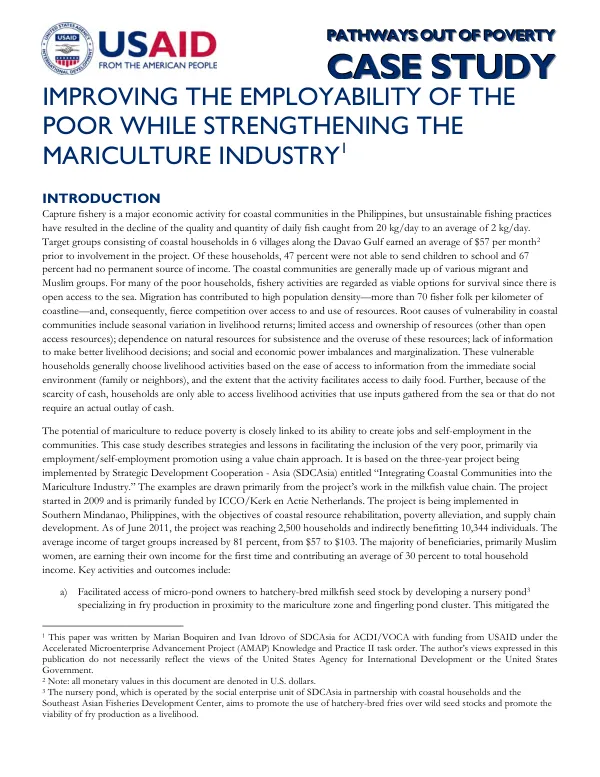
Improving the Employability of the Poor While Strengthening the Mariculture Industry
Sign inACDI/VOCA
Improving the Employability of the Poor While Strengthening the Mariculture Industry
In the Philippines, capture fishery is a major economic activity for coastal communities, but unsustainable fishing practices have resulted in the decline of the quality and quantity of daily fish caught from 20 kg/day to an average of 2 kg/day.
2012 · 7 pages
Sign in to readA free account is required to download.
Abstract
Target groups consisting of coastal households in 6 villages along the Davao Gulf earned an average of $57 per month. The potential of mariculture to reduce poverty is closely linked to its ability to create jobs and self-employment in the communities. The project "Integrating Coastal Communities into the Mariculture Industry" was implemented by Strategic Development Cooperation - Asia (SDCAsia) in Southern Mindanao, Philippines, with the objectives of coastal resource rehabilitation, poverty alleviation, and supply chain development. The project started in 2009 and is primarily funded by ICCO/Kerk en Actie Netherlands. As of June 2011, the project was reaching 2,500 households and indirectly benefitting 10,344 individuals. The average income of target groups increased by 81 percent, from $57 to $103. The coastal communities are generally made up of various migrant and Muslim groups. For many of the poor households, fishery activities are regarded as viable options for survival since there is open access to the sea. Migration has contributed to high population density—more than 70 fisher folk per kilometer of coastline—and, consequently, fierce competition over access to and use of resources. Root causes of vulnerability in coastal communities include seasonal variation in livelihood returns; limited access and ownership of resources (other than open access resources); dependence on natural resources for subsistence and the overuse of these resources; lack of information to make better livelihood decisions; and social and economic power imbalances and marginalization. The project facilitated access of micro-pond owners to hatchery-bred milkfish seed stock by developing a nursery pond, specializing in fry production in proximity to the mariculture zone and fingerling pond cluster. This mitigated the seasonality of operations, promoted optimal utilization of ponds, and reduced production costs and fingerling mortality. The project also promoted simplified Good Aquaculture Practices (GAqP) protocols anchored on indigenous technology and training of community-based providers to facilitate implementation and compliance among farmers. The project facilitated upgrading of post-harvest facilities and the capacity of the coastal poor to provide post-harvest and other logistical services. This has reduced post-harvest losses, and provided employment and a venue for trading activities involving the poor. The project also supported the set-up of community-based processing of milkfish products, which provides employment for women, promotes value addition, facilitates market entry, and provides a healthy protein source to consumers.
Related documents