USAID DEC
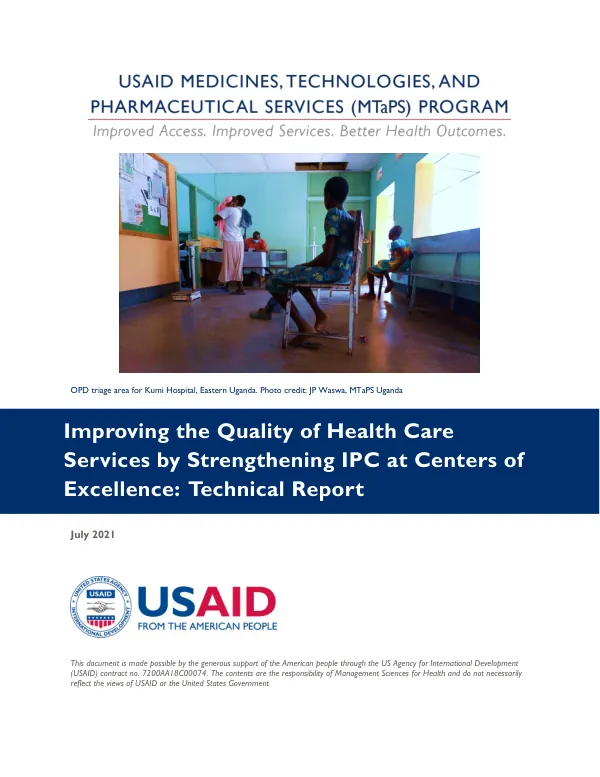
Improving the Quality of Health Care Services by Strengthening IPC at Centers of Excellence: Technical Report
Sign inDELOITTE USA
Improving the Quality of Health Care Services by Strengthening IPC at Centers of Excellence: Technical Report
The USAID Medicines, Technologies, and Pharmaceutical Services (MTaPS) Program is a global health initiative that aims to strengthen pharmaceutical systems in low- and middle-income countries.
2021 · 31 pages
Sign in to readA free account is required to download.
Abstract
In Uganda, MTaPS is supporting the national action plan for antimicrobial resistance (AMR) by implementing infection prevention and control (IPC) and hand hygiene (HH) interventions in 13 health facilities (HFs). The program is led by Management Sciences for Health (MSH) and implemented in partnership with various global and local organizations. The MTaPS Program in Uganda focuses on improving IPC and HH practices in HFs, with the ultimate goal of reducing healthcare-associated infections (HAIs) and antimicrobial resistance. To achieve this, MTaPS applied World Health Organization (WHO) tools to assess IPC and HH capacity, knowledge, and perceptions of healthcare workers (HCWs) and senior managers in 13 HFs. The tools were applied in the HFs by MTaPS technical officers, and steps were taken to ensure correct application of the tools and interpretation of the results. The assessment revealed an average Infection Prevention and Control Assessment Framework (IPCAF) score of 476/800 (SD 119) for the 13 HFs, indicating an intermediate-level rating. Most of the HFs rated intermediate, and none rated inadequate. Notably, there was an increase in average IPCAF scores between the two assessments, indicating improvement in IPC practices over time. The MTaPS Program in Uganda has implemented various interventions to improve IPC and HH practices in HFs. These interventions include training HCWs on IPC and HH practices, providing HCWs with personal protective equipment (PPE), and promoting the use of alcohol-based hand rub (ABHR) and soap. The program has also established a system for monitoring and evaluating IPC and HH practices in HFs. The results of the assessment indicate that there is still room for improvement in IPC and HH practices in HFs in Uganda. However, the increase in average IPCAF scores between the two assessments suggests that the MTaPS Program is making progress in improving IPC practices in HFs. To sustain this progress, the program will continue to implement interventions to improve IPC and HH practices in HFs and provide technical assistance to HFs to strengthen their IPC and HH capacity. The MTaPS Program in Uganda has also identified several challenges that need to be addressed to improve IPC and HH practices in HFs. These challenges include limited resources, inadequate infrastructure, and lack of awareness among HCWs and senior managers about the importance of IPC and HH practices. To address these challenges, the program will continue to work with HFs to identify solutions and provide technical assistance to strengthen their IPC and HH capacity. In conclusion, the MTaPS Program in Uganda is making progress in improving IPC and HH practices in HFs. However, there is still room for improvement, and the program will continue to work with HFs to strengthen their IPC and HH capacity and reduce HAIs and antimicrobial resistance.
Related documents