USAID DEC
INCENTIVES, FERTILITY BEHAVIOR, AND INTEGRATED COMMUNITY DEVELOPMENT; AN OVERVIEW
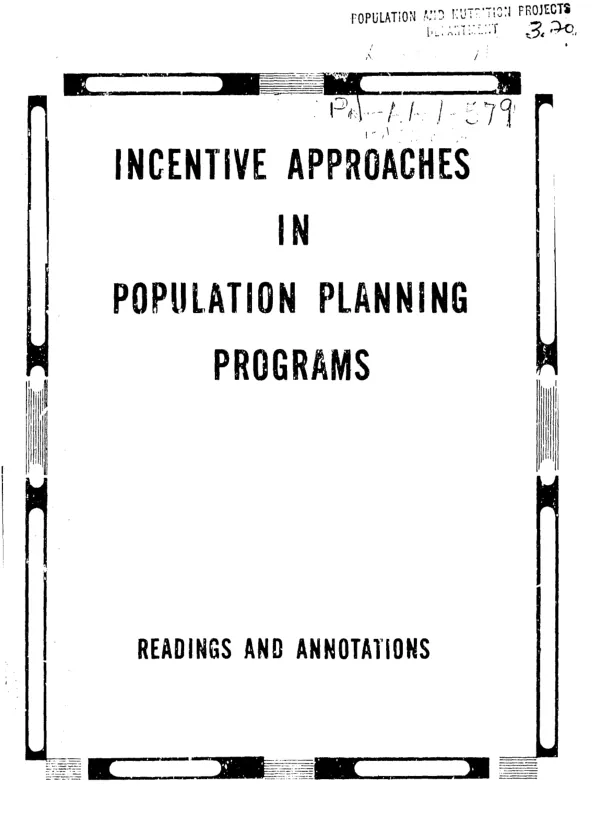
Developing country population policies are often reinforced with incentives to reward those who limit the number of births.
DAVID, HENRY P. · 1980
Sign in to readA free account is required to download.

Abstract
The range of incentives used in Bangladesh, China, India, Indonesia, Korea, the Philippines, Singapore, Sri Lanka, Taiwan, Thailand, and regions of Africa and Asia are reviewed in this paper. Both financial incentives (e.g., cash, preference in housing and land assignments, additional pensions and medical care) and disincentives (e.g., salary deductions) are utilized. A review of pertinent literature indicates that the use of incentives and disincentives to control population growth, if implemented in a balanced, non-discriminatory way, is not incompatible with human right policies. Illustrating this point, Thailand"s Planned Parenthood Association has pioneered an imaginative and successful community-based family planning (FP) service program (CBFPS) which has evolved into a broader program integrating FP initiatives into a broad range of community development projects. Most important among the author"s findings are: (l) little knowledge exists about what type of incentives are actually effective in reducing births; (2) disincentives are more readily accepted when other forms of fertility control are available, when FP policies are based on a consensus between citizens and government officials, and when discrimination against children born in disregard of official policies is avoided; (3) FP policies are better received when they are oriented to community development, are sensitive to local needs, and allow local autonomy; and (4) consideration of the psychosocial and economic determinants of fertility is a necessary FP program ingredient. To ensure better FP program planning, the author recommends that: (1) the uses of U.S. Government funds for FP programs be reviewed, particularly for the integrated community development schemes that enjoy local support; (2) the psychosocial and economic determinants of fertility behavior in successful FP programs be determined; (3) an interdisciplinary seminar of FP programmers be convened to discuss problems and to determine successful program ingredients; and (4) financing for Thailand"s CBFPS program for Cambodian and Laotian refugees be continued. A 183-item bibliography (1957-80) is appended.
Related documents