USAID DEC
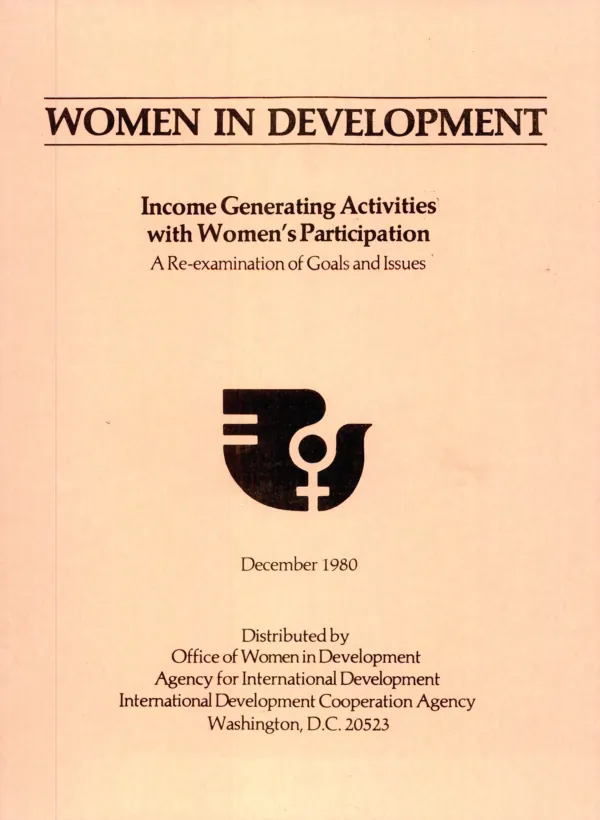
Income generating activities with women"s participation : a re-examination of goals and issues
Sign inUSAID. BUR. FOR PROGRAM AND POLICY COORDINATION. OFC. OF WOMEN IN DEVELOPMENT
Income generating activities with women"s participation : a re-examination of goals and issues
At the Mid-Decade of the Woman conference held in Copenhagen, Denmark, women from developing countries with diverse economic, social, and political backgrounds expressed a common, vital interest in income-generating projects (IGP).
Hoskins, Marilyn W. · 1980
Sign in to readA free account is required to download.
Abstract
This paper addresses three key issues raised at the conference regarding women"s IGP"s: IGP goals, women"s participation in IGP"s, and the need for illustrative case studies of the first two issues. Women"s IGP"s are defined as including all self-supporting and profit-making projects in which economic, social, and political benefits accrue to and are controlled by women. Economic benefits are particularly appropriate for women, who are increasingly responsible for family support, and help increase women"s stature in male-oriented home, economic, and social structures. Social benefits accrue through the formation of women"s groups which enable women to control their personal safety, wages, and working conditions, and to obtain increased legal representation. Through membership in local, national, and international groups, women have become increasingly aware of their political rights and responsibilities. Such awareness can lead to increased access to government services. In practice, however, social and political benefits are often unobtainable due to prohibitions on women"s organizations, while many women"s IGP"s are economically exploitative and dead-end as they are geared to crafts and manual skills which are soon supplanted by new technology or leave the revenue in male hands. To avoid these shortfalls as well as the false expectations arising from non-viable IGP"s, women"s participation in choosing, planning, implementing, and evaluating IGP"s is essential. Such participation, however, can only occur within women"s traditional social and familial roles. In addition, women"s IGP"s should be tied into larger national development programs in which funding, technical assistance, and training opportunities are more accessible. The report concludes by assessing the benefits of nine women"s IGP"s based on different organizational strategies. A 12-item bibliography (1978-80) and tables of project participation and impacts are included.