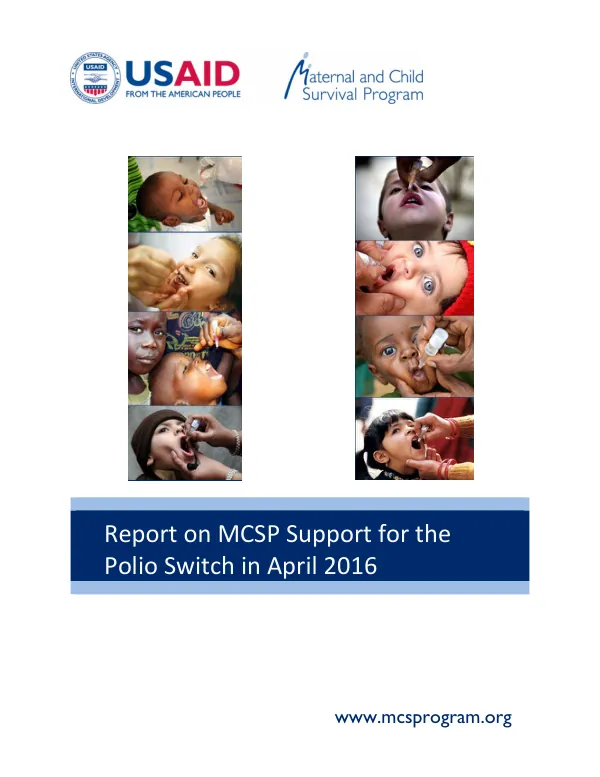
USAID'S MATERNAL AND CHILD SURVIVAL PROGRAM/JOHN SNOW, INC.
Indicators that Describe the Strength of the Routine Immunization System
The Maternal and Child Survival Program (MCSP) is working to advance global learning on the effective use of process indicators for strengthening routine immunization.
2018 · 4 pages
Sign in to readA free account is required to download.
Abstract
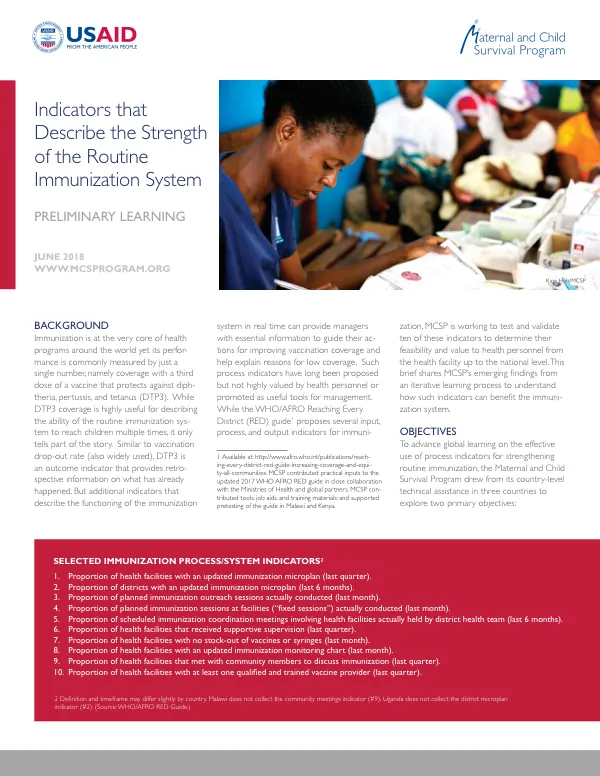
MCSP drew from its country-level technical assistance in three countries to explore two primary objectives: to advance global learning on the effective use of process indicators for strengthening routine immunization, and to explore health facility and district staff's understanding and utilization of a selected set of process indicators. MCSP selected 10 process indicators for routine immunization among the indicators in the AFRO RED guide that countries commonly monitor. The selected indicators include proportion of health facilities with an updated immunization microplan, proportion of districts with an updated immunization microplan, proportion of planned immunization outreach sessions actually conducted, and proportion of health facilities with no stock-out of vaccines or syringes. MCSP worked with country staff to select these indicators and conducted a mixed-methods approach to monitor the indicators in MCSP-supported districts/states over a period of a year. Qualitative findings from the first round of data analysis indicate that the selected process indicators allowed health workers to understand system performance at a glance and encourage discussion of the root causes of poor performance. Respondents widely stated that the indicators were useful for identifying stakeholders to support the system and providing accountability to funders and communities. However, some respondents stated that many health workers do not analyze the data and are not encouraged to do so by their supervisors. The indicators were found to be easy to collect, but time constraints and lack of health worker remuneration made data collection difficult in general. The indicators were also found to be useful for identifying areas for improvement and providing a measure of performance beyond coverage. Decision-makers must consider the context in which they analyze process indicator data, as seen in the example of Nigeria, where process indicator values are high due to recent efforts to strengthen the routine immunization system, but additional information indicates that much more is required to have an effect on coverage. The selected process indicators show a sustained increase in performance since 2015 in Malawi, pointing to an underlying strong system and correlating with improvements in coverage. In Nigeria, process indicator values are high as a result of recent efforts, but additional information indicates that much more is required to have an effect on coverage. The indicators provide a measure of performance beyond coverage and can be used to identify areas for improvement and provide accountability to funders and communities. The use of process indicators can encourage discussion of the root causes of poor performance and provide a measure of performance beyond coverage. The indicators can be used to identify stakeholders to support the system and provide accountability to funders and communities. However, decision-makers must consider the context in which they analyze process indicator data and consider additional information to have a comprehensive understanding of the system's performance. The selected process indicators can be used to identify areas for improvement and provide a measure of performance beyond coverage. The indicators can be used to encourage discussion of the root causes of poor performance and provide a measure of performance beyond coverage. The use of process indicators can provide a comprehensive understanding of the system's performance and identify areas for improvement.