BROAD BRANCH ASSOCIATES
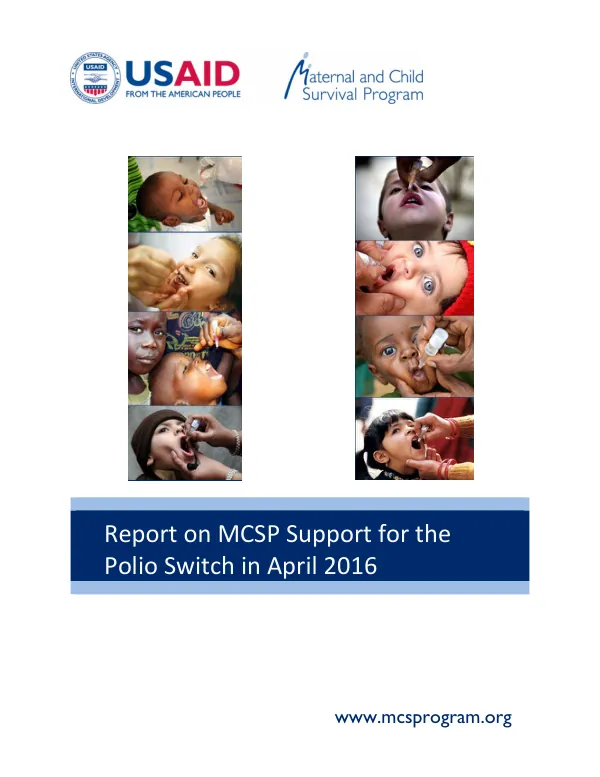
Report on MCSP Support for the Polio Switch in April 2016
The global effort to eradicate polio, spearheaded by Rotary International, the U.S.
2016 · 12 pages
Sign in to readA free account is required to download.
Abstract
Centers for Disease Control and Prevention, the World Health Organization (WHO), UNICEF, and the Bill & Melinda Gates Foundation, began in earnest 26 years ago. The U.S. Government has provided about $2 billion of the $11 billion spent thus far on polio eradication. The U.S. Agency for International Development (USAID) has played a critical role, recognizing and raising the importance of mobile populations, cross-border coordination, communications, and the need for more women vaccinators. In April 2016, the largest and fastest globally-coordinated project in the history of immunization was carried out in 155 countries and territories. Known as "the switch," this activity entailed replacing trivalent oral polio vaccine (tOPV), which protects against all three strains of the poliovirus, with the bivalent form (bOPV) which protects against two strains, types 1 and 3. The last case of polio due to type 2 wild virus was detected in 1999, and the virus was declared eradicated in 2015. This switch, synchronized with the introduction of inactivated polio vaccine (IPV), will help to achieve the aim of global eradication of polio while eliminating the risk of vaccine-associated paralytic polio and circulating vaccine-derived polio virus due to type 2 virus. The Maternal Child Survival Program (MCSP) is USAID's global flagship program to further the Agency's goal of ending preventable child and maternal deaths. MCSP works with other global, regional, and country partners to improve the coverage, quality, and sustainability of high-impact reproductive, maternal, newborn, and child health interventions at scale. In immunization, MCSP works to build institutional and individual capacity to manage routine immunization programs, strengthen routine immunization systems, and implement innovative and tailored approaches in countries for sustainable and equitable access to immunization. MCSP provides technical support to USAID polio eradication efforts and disease control in a number of countries and at the global level. The key areas of intervention in the Program include increasing the birth dose of the oral polio vaccine (OPV), introducing IPV, documenting and sharing lessons learned, providing technical support to outbreak response, and providing inputs to advisory groups including legacy planning. To systematically document MCSP's contribution to the switch and IPV introduction, a survey was sent to MCSP field staff in the 11 countries where MCSP supported the process. The switch from tOPV to bOPV was scheduled to occur in the second half of April 2016. All countries interviewed were successful in carrying out the switch by this time. In Zimbabwe, it occurred with a slight delay on 1 May 2016. By the end of April 2016, IPV had been introduced in seven of these 11 countries: Haiti, Kenya, Madagascar, Mozambique, Nigeria, Pakistan, and Uganda. The first country to introduce IPV was Nigeria in February 2015, and the last was Uganda in April 2016. In Tanzania, Malawi, and Zimbabwe, IPV could not be introduced in April 2016 because of a global shortage of IPV; these countries were not considered high risk by WHO, and therefore, were given lower priority for needing the vaccine. In all 11 countries, the Expanded Program on Immunization under the ministries of health played the central coordinating and implementing role for the switch. Institutions had varied roles within each country; in general, they were responsible for resource mobilization, planning and coordinating the switch, training, and producing and updating materials. The switch was a complex process that required coordination and collaboration among multiple stakeholders, including national institutions, international agencies, and community organizations.
Related documents