WORLD TRADE ORGANIZATION
INDO-AFRICA SYNERGY ALONG THE COTTON VALUE CHAIN
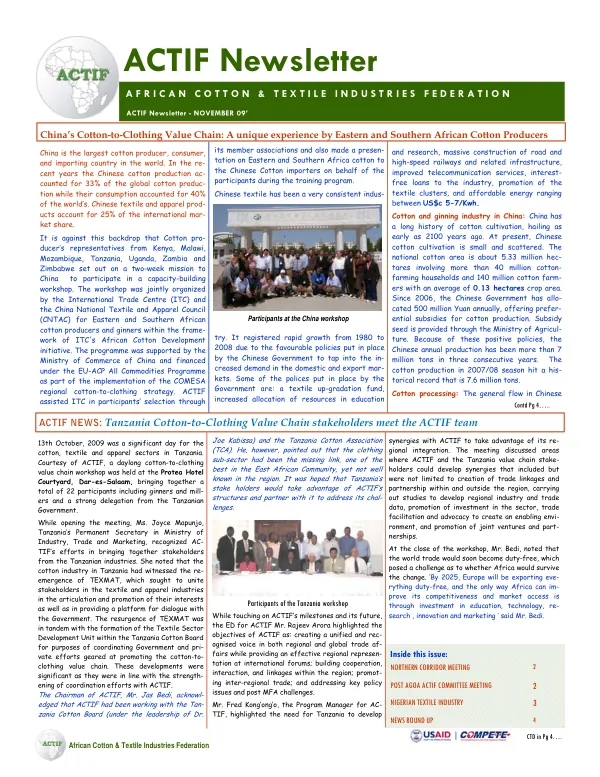
The African Cotton and Textile Industries Federation (ACTIF) is a not-for-profit regional industry/trade body formed in June 2005 by the Cotton, Textile, and Apparel sectors from Eastern and Southern Africa.
2011 · 10 pages
Sign in to readA free account is required to download.
Abstract
ACTIF covers the COMESA, SADC, and the EAC trading blocks and includes members from 19 countries. The federation's mandate is to bring the disparate needs of the cotton, textile, and apparel sectors into a cohesive and consensus-driven position at regional and international trade and development forums. ACTIF works in partnership with various organizations, including the International Trade Center (ITC), to promote improved competitiveness in the regional and global market place. The ITC is an international organization that works in partnership with the World Trade Organization (WTO) and the United Nations Conference on Trade and Development (UNCTAD) to support developing countries in achieving sustainable development through exports. In 2010, ACTIF participated in a South-South cooperation program along the cotton value chain in India, which was sponsored by the ITC. The program brought together participants from Ethiopia, Kenya, Malawi, Mozambique, Tanzania, Uganda, Zambia, and Zimbabwe. The participants were drawn from various sections of the cotton value chain in Africa, including farmers, ginners, government agencies, financial institutions, and trade bodies. During the program, ACTIF was able to introduce itself to some of the major support institutions in India, including Bajaj Steel Ltd, CIRCOT, CIT, Gujarat State Cooperative Cotton Federation (GUJCOT), and the Ministry of Agriculture, state of Gujarat. ACTIF also participated in various networking sessions, meeting potential input suppliers who are keen to support the African cotton sector and various accrediting agencies who expressed their willingness to work with the African industries to attain international standards for export. The overall objective of the South-South cooperation activity was to build capacity and develop linkages, enhance trade, and build corporate and associate membership. Others were to review progress of cotton value chain research and development in India, understand how the government supports the farming sector, how cooperative farming is structured, the potential to source agricultural inputs, market prospects for lint exports to India, and how to develop cooperation for building the cotton value chain in Africa with the support of public-private partnership (PPP) from India. India has a well-developed cotton, textile, and apparel sector, ranking second globally in cotton production and contributing significantly to the nation's economy. The success can be attributed to cotton technology, Mini Missions, a strategy that connects all the players across the value chain in the development of the cotton sector, as well as intensive research on cotton varieties and adoption of latest technology. Information flow is well-coordinated across the cotton value chain, right from the farm level, upwards, and each player is informed about the cotton varieties, prices, and the world situation. The government, through the minimum support price, is able to support the farming sector and ensure a stable supply of cotton to the textile industry.