USAID DEC
ACTIF Newsletter: African Cotton & Textile Industries Federation
The African Cotton and Textile Industries Federation (ACTIF) is a regional organization that aims to promote the interests of the cotton and textile industries in Eastern and Southern Africa.
2009 · 4 pages
Sign in to readA free account is required to download.
Abstract
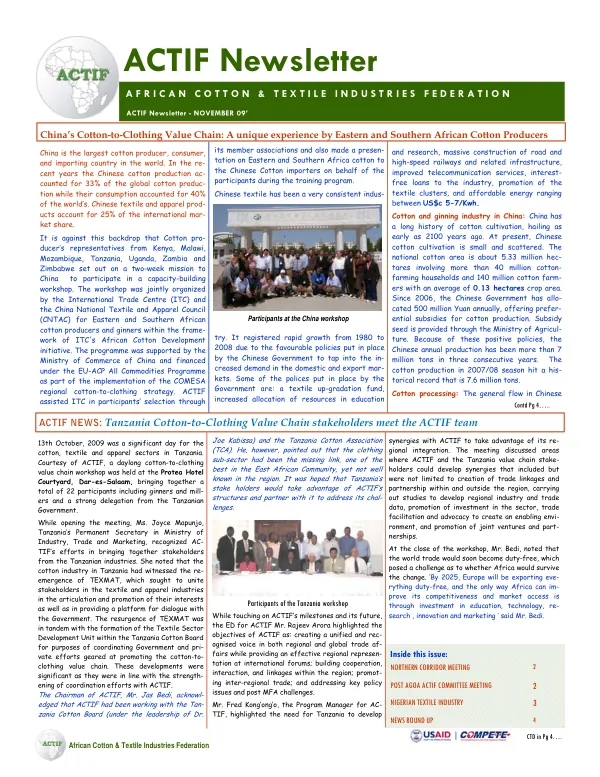
ACTIF has been working with various stakeholders, including governments, private sector companies, and international organizations, to improve the competitiveness of the region's cotton and textile industries. One of the key initiatives undertaken by ACTIF is the capacity-building program for cotton producers in Eastern and Southern Africa. In 2009, a group of cotton producers from Kenya, Malawi, Mozambique, Tanzania, Uganda, Zambia, and Zimbabwe participated in a two-week mission to China to participate in a capacity-building workshop. The workshop was jointly organized by the International Trade Centre (ITC) and the China National Textile and Apparel Council (CNTAC) for Eastern and Southern African cotton producers and ginners. The workshop focused on building the capacity of the participants in areas such as cotton production, processing, and marketing. The participants also had the opportunity to learn about the Chinese cotton and textile industry, which is one of the largest in the world. The Chinese cotton industry has been growing rapidly over the past few decades, driven by favorable policies and investments in infrastructure and technology. The Chinese cotton industry has a long history, dating back over 2,100 years. At present, Chinese cotton cultivation is small and scattered, with a national cotton area of around 5.33 million hectares involving over 40 million cotton-farming households and 140 million cotton farmers. The Chinese government has been providing subsidies to cotton farmers, which has helped to increase cotton production in the country. The Chinese textile industry has also been growing rapidly, driven by investments in technology and infrastructure. The industry has been able to take advantage of the country's large domestic market and has become a major player in the global textile industry. Chinese textile products account for around 25% of the international market share. In addition to the capacity-building program, ACTIF has also been working with stakeholders in Tanzania to develop the country's cotton-to-clothing value chain. In October 2009, a daylong workshop was held in Dar-es-Salaam, bringing together stakeholders from the Tanzanian cotton, textile, and apparel industries. The workshop aimed to promote synergies between ACTIF and the Tanzanian value chain stakeholders, including the creation of trade linkages and partnerships within and outside the region. The workshop was attended by a total of 22 participants, including ginners and millers, as well as a strong delegation from the Tanzanian government. The participants discussed areas where ACTIF and the Tanzanian value chain stakeholders could develop synergies, including the creation of trade linkages and partnerships, the promotion of investment in the sector, trade facilitation, and advocacy to create an enabling environment. The Northern Corridor is a transport corridor linking the Great Lakes countries of Burundi, D.R. Congo, Rwanda, and Uganda to the Kenyan sea port of Mombasa. The corridor also serves Northern Tanzania, Southern Sudan, and Ethiopia. In September 2009, a conference was held in Mombasa to discuss ways of reducing the cost of doing business in the Northern Corridor. The conference was sponsored and organized by the Northern Corridor Transit Transport Coordination Authority, East African Business Council, Kenya Ports Authority, East African Community Secretariat, Common Market for Eastern and Southern Africa Secretariat, and USAID/COMPETE. The conference brought together key ministers from the five EAC countries, including D.R. Congo and Southern Sudan, to address transit and trade facilitation challenges on the Northern Corridor. ACTIF was represented at the conference by six representatives from the secretariat and national associations from Ethiopia, Uganda, and Kenya. Mr. Jaswinder Bedi delivered a presentation entitled: Impact of Existing Transit/Transport Regimes on Exports - Experiences from the Cotton Sector.
Related documents