USAID
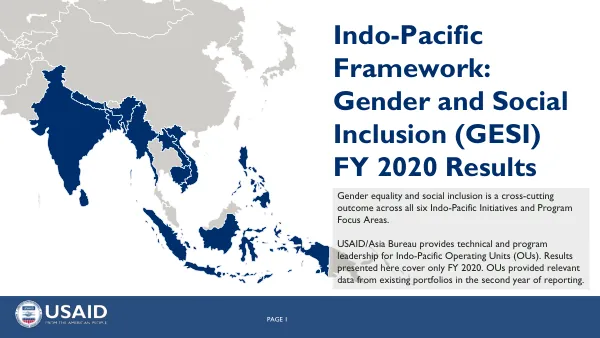
Indo-Pacific Framework: Gender and Social Inclusion (GESI) FY 2020 Results
The Indo-Pacific Framework for Gender and Social Inclusion (GESI) FY 2020 Results highlights the cross-cutting outcome of gender equality and social inclusion across six Indo-Pacific Initiatives and Program Focus Areas.
2020 · 18 pages
Sign in to readA free account is required to download.
Abstract
USAID/Asia Bureau provides technical and program leadership for Indo-Pacific Operating Units (OUs), which provided relevant data from existing portfolios in the second year of reporting. Programming under the Indo-Pacific Framework addresses inclusive development and engages and empowers marginalized communities. USAID works to improve gender equality and social inclusion outcomes across each of the six IPF Initiatives and Program Focus Areas, including the Indo-Pacific Transparency Initiative, Digital Connectivity and Cybersecurity Partnership Initiative, Infrastructure Transaction and Assistance Network Initiative, Asia Enhancing Development and Growth through Energy Initiative, Trade and Competitiveness Program Focus Area, and Natural Resources Safeguards and Security Program Focus Area. In Bangladesh, USAID's Expanding Participation of People with Disability (EPD) Activity advances disability rights and supports Disabled Persons Organizations (DPOs), carries out legal aid camps, and trains district-level government officials and civil society representatives about the Disabled Persons' Rights and Protection Act, 2013 (DRPA). Women-led DPOs and human-rights defenders are continuously trained on the DRPA 2013, resulting in the first legal complaint filed under the DRPA law in the Barishal District by a woman with disabilities. In Cambodia, the "We are the Same" Activity has helped advance LGBTI rights and promote awareness and protection. USAID supported the design of a Facebook information sharing page on LGBTI rights in Cambodia, which has reached over 9 million people since its inception in June 2016 to March 2020. The Activity also held a roundtable discussion broadcasted on a popular television news station, and an end-line survey found that Cambodians participating in the Activity had increased their understanding of LGBTI rights by 30 percent. In India, the Producer-Owned Women Enterprises (POWER) Activity is empowering women to become micro-entrepreneurs who collectively own and operate production companies. In FY 2020, the Activity established seven production units benefitting 1,857 underprivileged women, conducted 41,085 person days of training for women on technical skills, and established market linkages with retailers such as IKEA. As a result, the women's income increased by 13 percent, and 1,283 women were able to access social security benefits. In Indonesia, a USAID workforce development grant increased skills training and employment opportunities for marginalized groups, including women and people with disabilities. The grant supported the development of a vocational training program for women, which resulted in a 25 percent increase in women's participation in the workforce. In Burma, USAID launched a solicitation for local civil society organizations to establish a 24-hour hotline for victims of sexual and gender-based violence (GBV) who are unable to access mainstream services. Additionally, MDCDA assisted 70 victims of domestic violence and other forms of SGBV to relocate to safer locations and provide sign language interpretation throughout the legal process. The Indo-Pacific Framework for GESI FY 2020 Results highlights the progress made in promoting gender equality and social inclusion across the Indo-Pacific region. The results demonstrate the impact of USAID's programming in empowering marginalized communities, including women, people with disabilities, and LGBTI individuals, and promoting inclusive development and economic opportunities.
Related documents