U.N. WOMEN
FY 2021 Results: Gender Equality and Social Inclusion
The Indo-Pacific Strategy (IPS) Initiatives/Program Focus Areas emphasized gender equality and social inclusion (GESI) in Fiscal Year (FY) 2021.
2021 · 9 pages
Sign in to readA free account is required to download.
Abstract
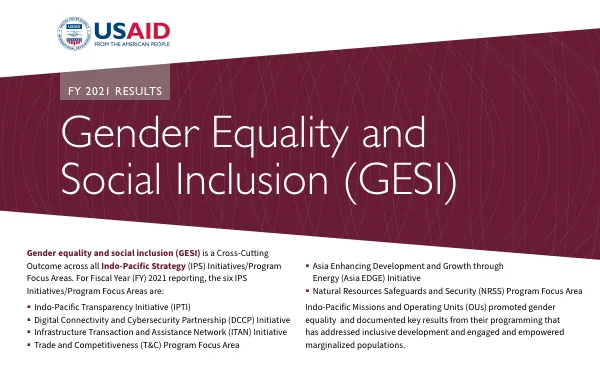
The six IPS Initiatives/Program Focus Areas are the Indo-Pacific Transparency Initiative (IPTI), Digital Connectivity and Cybersecurity Partnership (DCCP) Initiative, Infrastructure Transaction and Assistance Network (ITAN) Initiative, Trade and Competitiveness (T&C) Program Focus Area, Asia Enhancing Development and Growth through Energy (Asia EDGE) Initiative, and Natural Resources Safeguards and Security (NRSS) Program Focus Area. The Indo-Pacific Missions and Operating Units promoted gender equality and documented key results from their programming that addressed inclusive development and engaged marginalized populations. The Indo-Pacific Transparency Initiative (IPTI) supported the ASEAN Committee for Women (ACW) and ASEAN Commission on the Promotion and Protection of the Rights of Women and Children (ACWC) in reaching two key regional milestones advancing gender equality, women's empowerment, and the Women, Peace, and Security (WPS) commitments in FY 2021. The Women's Livelihood Bond II (WLBII) provided loans to support privately owned micro, small, and medium enterprises (MSMEs), including enterprises operating in the sustainable agriculture and clean energy sectors, or microfinance institutions deemed to have a positive impact on women's livelihoods. WLBII is part of the larger Women's Livelihood Series delivered through the Singapore-based Impact Investment Exchange, with USAID-backed loan agreements managed by Development Finance Corporation. In Cambodia, USAID/Cambodia continued to support agricultural women-owned small and medium enterprises (W-SMEs) to be more competitive and to meet the demand for quality agricultural commodities in domestic and international markets. With assistance from Harvest II, 225 W-SMEs applied improved business management practices, which enabled them to better meet customers' needs and to expand their own businesses. As a result, 91 W-SMEs increased their profits. In Timor-Leste, USAID/Timor-Leste prioritized the participation of women in workshops, seminars, and awareness events, ensuring an overall female participation rate of 27 percent. USAID also partnered with the Timor-Leste Women's Business Association and supported them through workshops and training events that lowered the barriers to entry, provided informational materials to help navigate customs requirements, and created opportunities for dialogue and expanding networks. In the Philippines, USAID/Philippines' Regulatory Reform Support Program for National Development (RESPOND) Activity partnered with the Philippine Commission on Women to organize a series of six webinars to discuss pandemic-related challenges affecting women entrepreneurs and workers. The series, which was attended by more than 6,000 women entrepreneurs and allies, tackled strategies and tools for women entrepreneurs to better-manage online businesses, access digital markets and services, expand alternative work arrangements, and comply with business registration procedures. In Southeast Asia, USAID/RDMA's Enhancing Equality in Energy for Southeast Asia Activity and the American Chamber of Commerce organized a webinar on Women in Leadership to discuss initiatives addressing gender bias and share experiences of working in organizations that are overcoming these barriers. Panel representatives included USAID/RDMA's gender specialist, the Chevron Asia South Business Unit Manager, the Chairman and CEO of Thai Solar Energy, and the Chairman and Managing Director of Esso and ExxonMobil Thailand. Sixty attendees from energy and other companies in Thailand attended the webinar. In India, USAID/India's South Asia Regional Digital Initiative Activity launched digital training programs for 10,000 rural women entrepreneurs and 500 community development organizations in India across ten districts in seven states.