FAO
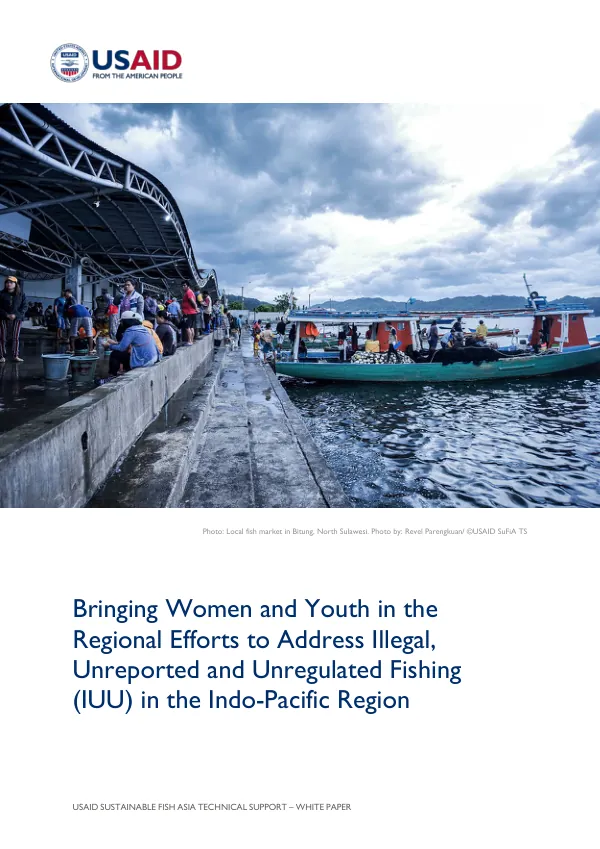
USAID Sustainable Fish Asia Technical Support – White Paper
Illegal, Unreported, and Unregulated (IUU) fishing activities pose significant threats to worldwide maritime security, global fish stocks, the economy, and the environment.
2023 · 16 pages
Sign in to readA free account is required to download.
Abstract
The Sustainable Development Goals (SDGs) of the United Nations and SDG14, "Life Below Water," reflect the growing concern of the severe consequences and extent of IUU fishing on a global scale. IUU fishing affects 30% of the world's fish stocks, threatening over three billion people who depend on marine and coastal biodiversity for their livelihoods. The U.S. Government has been a key partner in combating IUU fishing in the Asia-Pacific region, with various investments through the United States Agency for International Development Regional Development Mission for Asia (USAID/RDMA). The Sustainable Fish Asia Technical Support (SuFiA TS) Activity, implemented by USAID/RDMA from 2021 to 2025, aims to improve the management of marine biodiversity and fisheries resources in the Indo-Pacific region by reducing unsustainable and IUU fishing. The activity is committed to integrating gender equity and social inclusion (GESI) approaches in all its activities due to the inherent issues and challenges faced by men, women, migrants, youth, stateless fishers, and other marginalized social groups. The geographic scope of the SuFiA TS Activity includes 12 countries in Southeast Asia and the Pacific region: Brunei Darussalam; Cambodia; Indonesia; Laos; Malaysia; Myanmar; Papua New Guinea; the Philippines; Singapore; the Solomon Islands; Thailand; Timor Leste; and Vietnam. Systematic discrimination in the fisheries sector makes it challenging for women and marginalized social groups to participate in decision-making and access resources and information about their rights as equal contributors to the fishing and seafood industries. SuFiA TS conducted a GESI Analysis during its start-up to identify and assess pressing gender and social inclusion issues and constraints. The Analysis was developed around five domains: laws, policies, and institutional practices; gender roles, responsibilities, and time uses; access to and control over assets and resources; and patterns of social exclusion. The Analysis specified how proposed interventions would affect not only women but also youth, small-scale fishers, migrants, and other marginalized social groups. The SuFiA TS Activity structures its interventions using five Strategic Approaches: Adoption and implementation of regional sustainable fisheries policies, standards, and regulatory frameworks; Increase in the adoption of fair labor and sustainable fishing practices by fishery businesses in the region; Effective and efficient project coordination, administrative, and technical support, and outreach and communications; Improved social inclusion within regional fisheries management, including small-scale fishers, women, and youth empowerment; and Regional institutions and countries empowered to safeguard their fishery resources from foreign malign influences. The SuFiA TS Activity aims to provide technical services to advance regional fisheries policy and regulatory frameworks, promote the adoption of fair labor standards and sustainable fishing practices within the seafood industry, and strengthen regional fisheries management capacity. The activity's interventions are designed to address the pressing gender and social inclusion issues and constraints identified in the GESI Analysis, with a focus on empowering women, youth, small-scale fishers, migrants, and other marginalized social groups in the fisheries sector. The SuFiA TS Activity's geographic scope and focus on GESI approaches make it a critical initiative in addressing IUU fishing and promoting sustainable fisheries management in the Indo-Pacific region. By integrating GESI approaches into its interventions, the activity aims to address the systemic discrimination and social exclusion faced by women and marginalized social groups in the fisheries sector, ultimately contributing to the achievement of the SDGs and the conservation of marine biodiversity and fisheries resources.
Related documents