TETRA TECH
Indonesia Land Tenure and Property Rights Assessment
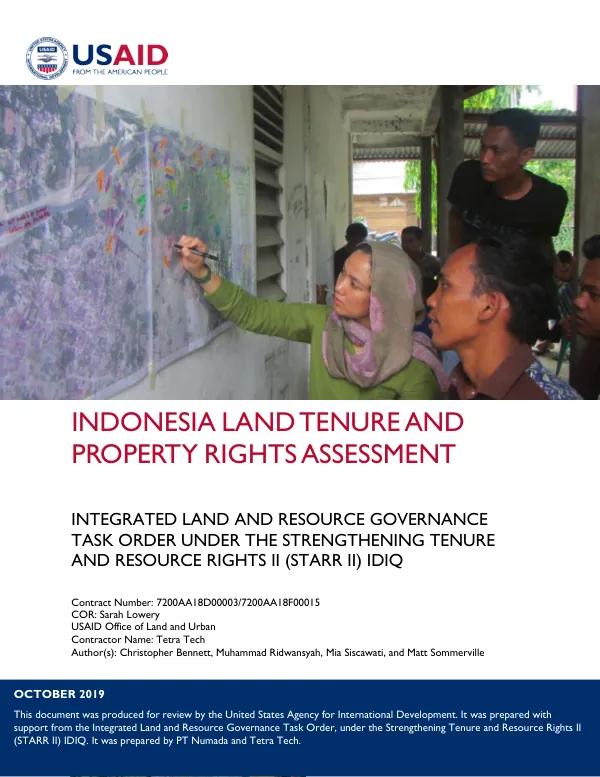
The Indonesia Land Tenure and Property Rights Assessment was conducted in 2019 under the Strengthening Tenure and Resource Rights II (STARR II) IDIQ.
2019 · 83 pages
Sign in to readA free account is required to download.
Abstract
The assessment aimed to identify the present situation and strategic opportunities for land tenure and property rights in Indonesia. The study employed USAID's Land Tenure and Property Rights Tool to analyze the current state of land tenure and property rights in Indonesia. The assessment revealed that land tenure and property rights in Indonesia are characterized by a complex and fragmented legal framework. The Basic Agrarian Law (BAL) and the Presidential Instruction (Inpres) No. 1/2015 on the Acceleration of Agrarian Reform are key laws governing land tenure and property rights in Indonesia. However, the implementation of these laws is often hindered by bureaucratic and institutional barriers. The assessment identified several barriers to action on land tenure and property rights in Indonesia, including limited awareness and understanding of land rights among communities, inadequate institutional capacity, and lack of coordination among government agencies. The study also highlighted the importance of engaging with local communities and indigenous peoples in the land tenure and property rights reform process. The assessment recommended several strategic directions for USAID's Country Development Cooperation Strategy (CDCS) 2020-2024, including strengthening the capacity of government agencies and local communities to implement land tenure and property rights reforms, promoting awareness and understanding of land rights among communities, and supporting the development of a more inclusive and equitable land tenure system. The assessment also highlighted the importance of addressing the gender dimensions of land tenure and property rights in Indonesia. The study found that women-headed households face significant barriers in accessing and securing land rights, and that the lack of women's participation in land tenure and property rights decision-making processes is a major obstacle to achieving gender equality. The assessment concluded that land tenure and property rights are critical components of Indonesia's development agenda, and that addressing these issues is essential for achieving the country's development goals, including the Sustainable Development Goals (SDGs). The study recommended that USAID and other development partners support the Indonesian government in its efforts to reform the land tenure and property rights system, and to promote more inclusive and equitable land tenure practices.
Related documents