USAID. MISSION TO PHILIPPINES
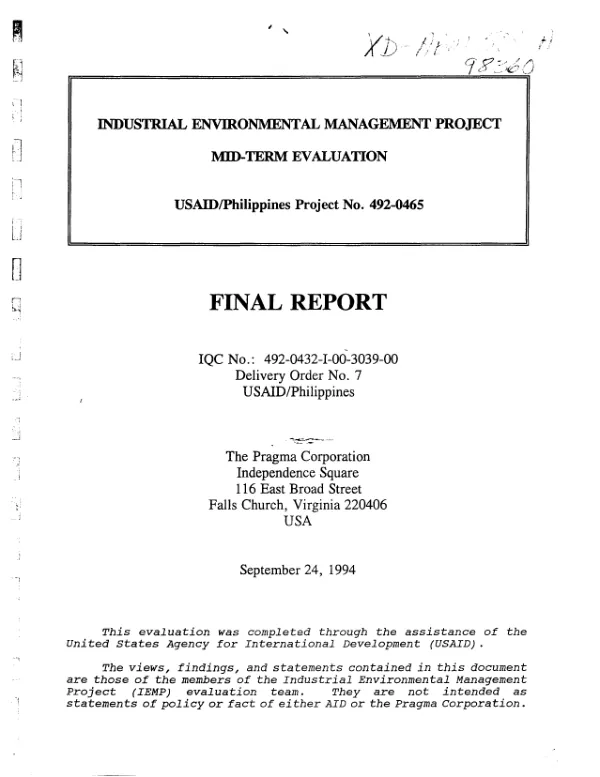
Industrial environmental management project
Summarizes attached mid-term evaluation (XD-ABM-508-A) of a project to reduce industrial pollution in the Philippines.
1995
Sign in to readA free account is required to download.
Abstract
The evaluation covers the period 9/91-9/94. The project should obtain most of its objectives by 9/96. In general, its contractors and grantees are carrying out the main activities in accordance with the project design and approved workplans. There remains a high degree of tension between industrial development and environmental protection from the perspective of the private sector, and even from a significant sector of the government bureaucracy, mainly due to the transaction and opportunity costs of implementing environmental standards and processing environmental compliance certificates. Also, there are serious constraints at the Department of Environment and Natural Resources (DENR) to implementing environmental management and regulation. Private sector support and cooperation is strong, however. There has been significant progress in implementing waste minimization and pollution reduction initiatives under the Pollution Management Appraisal (PMA) process. However, the PMA process needs improvements in collecting baseline data and in monitoring onsite PMAs. DENR regional staff"s participation in PMAs should be increased, and local government units (LGUs) and NGOs should be educated about the PMA process. Also, there is a lack of analytical laboratory facilities in the Philippines sufficient to support expansion of the PMA program. The project"s policy studies have generated strong private sector support for policy reform in the environmental sector. Studies conducted so far have contributed to the three pillars of the country"s emerging industrial environmental management framework: (1) strengthening and streamlining the environmental impact statement system; (2) using market-based instruments to complement command and control interventions; and (3) increasing reliance on LGUs and NGOs for environmental monitoring and management. In general, capacity-building activities are being implemented as planned, but suffer from the lack of a clear training strategy. Also, links to related capability-building efforts beyond the project should be strengthened and there should be more private industry participation. On the government side, there has been virtually no increase in capacity to sustain project activities. Staff training for DENR is a continuing need. The following lessons were learned. (1) New concepts and designs in environmental projects should avoid the usual rhetoric about saving the world for the next generation and focus instead, as this project has done, on the project"s direct and immediate impact on beneficiaries. The fact that pollution reduction and waste minimization provide immediate benefits to industry are reason enough for industry to sustain activities themselves. (2) Attitudinal change in the public sector is another requirement for sustainability. Future efforts should put the carrot before the stick (the stick being command and control efforts) -- provided the carrot is promoted by leaders in the regulatory community who understand the need for it. Willingness to change attitudes and institute reform are as important or more important than increasing funding for environmental projects. The Mission praised the evaluation, but noted that it did not fully discuss project strengths which could be used as a model for subsequent projects, especially promoting voluntary private participation in a government project, and advocating policy reform through the private rather than the public sector.
![Evaluation of the US-Asia environmental partnership [US-AEP]](https://covers.devme.ai/gen/5422.webp)
![Evaluation of the US-Asia environmental partnership [US-AEP]](https://covers.devme.ai/gen/44258.webp)