RICE UNIVERSITY
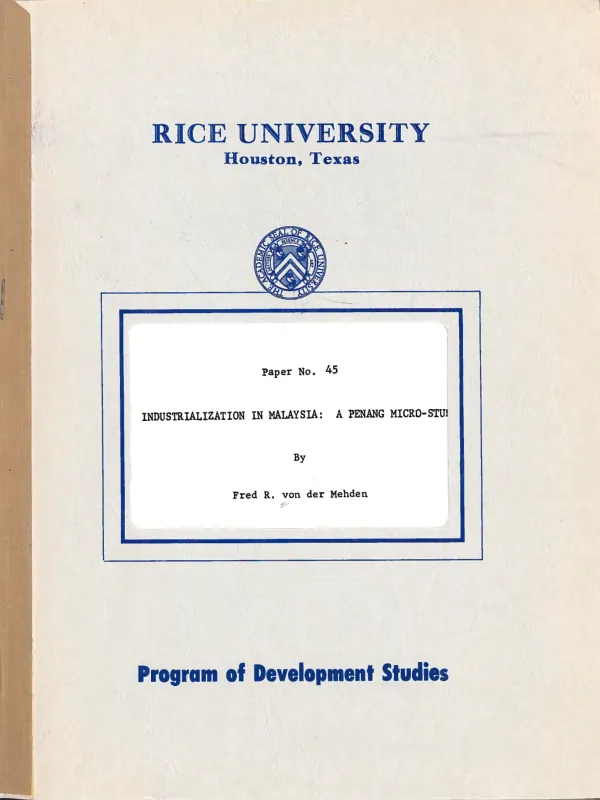
Industrialization in Malaysia : a Penang micro-study
The tying of aid is one of the means by which a country may avoid or postpone a devaluation when suffering a deficit in its balance of payments.
Hutcheson, Thomas L.; Porter, Richard C.
Sign in to readA free account is required to download.
Abstract
In its efforts to prevent foreign economic aid from hurting the balance of payments, the United States placed increasing restrictions during the 1960"s on the manner in which its aid could be spent. Although the tying techniques are rarely precise and the results are difficult to measure, it is now generally conceded that aid no longer has any substantial impact on the balance of payments. Inevitably, however, the very success of policies directed at changing the preferred expenditure patterns of the less developed countries (LDC"s) receiving aid has imposed costs on them. It is toward the identification and measurement of these costs that this paper is directed. The organization of the remaining sections is as follows. An historical review of aid-tying measures from the viewpoint of the United States is first presented (Section II). There follows a description of the aid negotiations between the Governments of the United States and Colombia and of the administrative reactions of the Colombian Government -- especially of its import-licensing agency -- to restrictions on the use of aid (Section III). Constraints by the donor on the use of aid and the reactions of the donee to them are then examined theoretically within a model allowing heterogeneity of varieties (Section IV). In the final two sections (V and VI), the data of actual Colombian imports over 1955-68 are analyzed in an effort to assess the nature, extent, and costs of the variety distortion imposed on Colombia in 1967 and 1968 as a result of the tying of aid from the United States and suboptimal Colombian responses to these restrictions.
Related documents