INSTITUTO COLOMBIANO PARA EL BIENESTAR FAMILIAR
Infografia JJR resultados
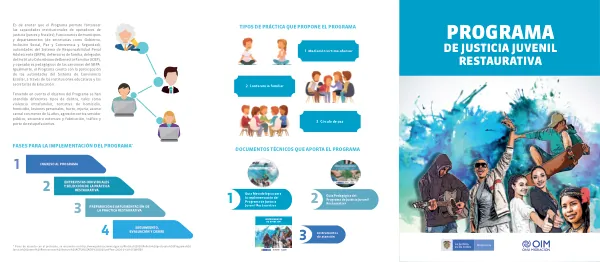
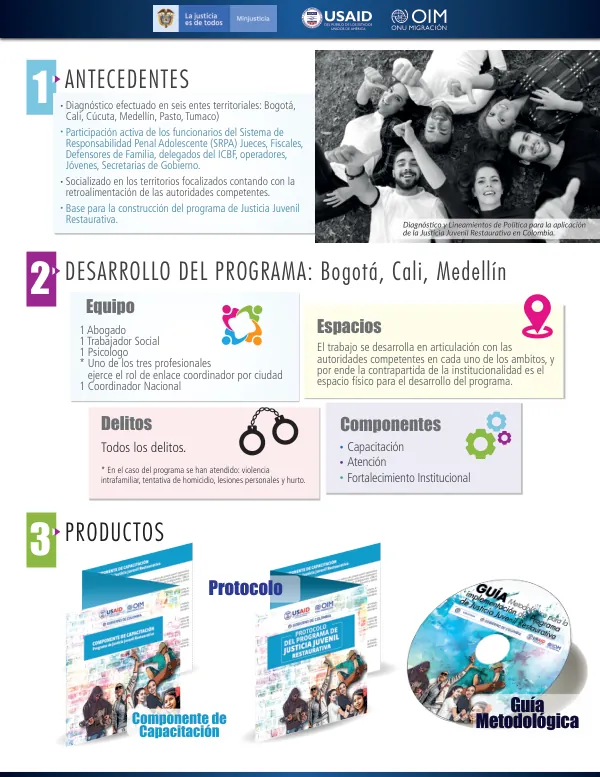
The Justicia Juvenil Restaurativa program in Colombia began with a diagnostic study conducted in six territorial entities: Bogotá, Cali, Cúcuta, Medellín, Pasto, and Tumaco.
2018 · 2 pages
Sign in to readA free account is required to download.
Abstract
The study involved active participation from officials of the Sistema de Responsabilidad Penal Adolescente (SRPA), including judges, prosecutors, defenders of the family, delegates from the ICBF, operators, young people, and secretaries of government. The findings from this study served as the basis for the construction of the Justicia Juvenil Restaurativa program. The program was developed in three cities: Bogotá, Cali, and Medellín. Each city had a team consisting of an abogado, a trabajador social, and a psicólogo, with one of the three professionals acting as the coordinator for the city. The program also had a national coordinator. The work was carried out in collaboration with the competent authorities in each of the areas, with the institutional counterpart providing the physical space for the program's development. The program aimed to address all types of delinquency, including intrafamilial violence, attempted homicide, personal injuries, and theft. The program's components included capacitación (training), atención (attention), fortalecimiento institucional (institutional strengthening), protocolo (protocol), guía (guide), and metodológica (methodological). The program also had a diagnostic and policy guidelines component for the application of juvenile restorative justice in Colombia. In Bogotá, the program received 49 cases, with 11 being focalized and 9 initiating attention. The program also had 2 cases with a restorative agreement and 2 cases that were closed due to the end of the academic year. In some cases, there were multiple victims or offenders involved. In Medellín, the program received 380 cases, with 1 case having a restorative agreement and 19 being focalized. The program also had 12 cases initiating attention and 6 cases with a restorative agreement. The program also had 7 cases that were closed, with 2 being sent to a spa, 1 to a psychiatric institution, and 3 being withdrawn. In Cali, the program received 114 cases, with 27 being direct and 18 indirect. The program also had 837 people (572 women and 265 men) who were attended, with 54 people (30 women and 24 men) being referred to other institutions. The program's pilot phase was evaluated, and the results showed that the program was effective in reducing delinquency and improving the lives of young people. The program also had a strong focus on socialization and communication, with the goal of making the program a national public policy to be implemented. The program's sustainability and transferability were also a key focus, with the goal of transferring the model to other operators, educational institutions, and judges.
Related documents